Hip Labral Repair
Hip labral repair reattaches the ring of tissue around the hip socket.
Educational content only • Not a substitute for medical advice • For emergencies call 911
Why this procedure may be recommended
A labral tear can cause:
- deep groin or front-of-hip pain
- clicking, catching, or locking
- pain with sitting, twisting, squatting, or sports
- a feeling that the hip is not moving smoothly
Labral tears can happen from:
- femoroacetabular impingement (FAI), which means the ball and socket pinch because of bone shape
- injury
- hip dysplasia, when the socket does not cover the ball as well as usual
- wear over time
Surgery may be considered when symptoms, exam findings, and imaging all point to the labrum as an important cause of pain, and when rest, activity changes, medicines, injections, or physical therapy have not helped enough.
Not every labral tear needs surgery. Some tears do not cause symptoms, and some hips are better treated in other ways.
Anatomy and imaging
These illustrations and imaging examples can help you understand the anatomy. They do not show your diagnosis.
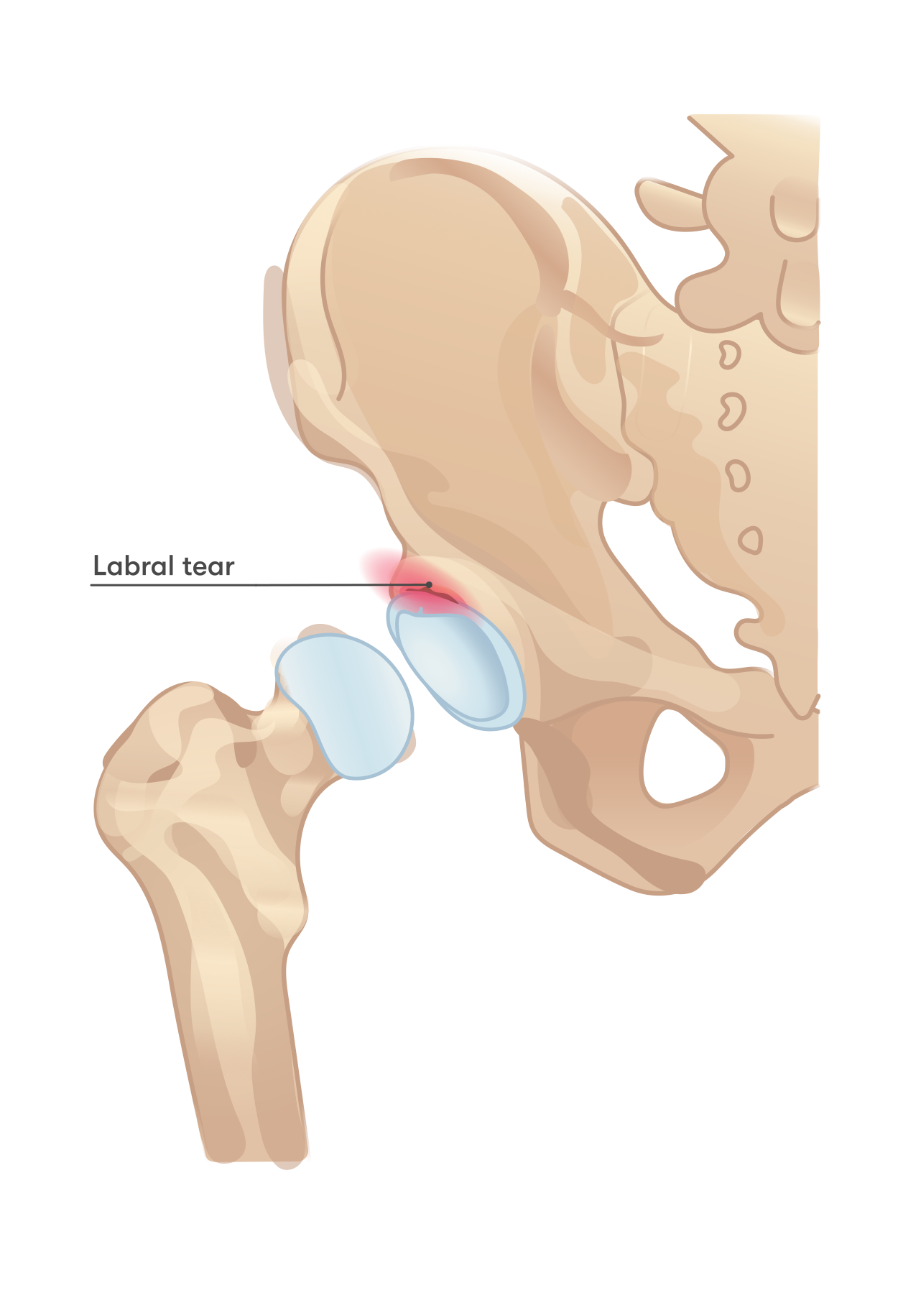
Simplified illustration of a hip labral tear.
Image and video credits
Labral tear 2 (opens in a new tab) — InjuryMap. CC BY-SA 4.0 (opens in a new tab).
Silent comparison of common FAI shapes.
Text description
The animation compares normal hip shape with cam, pincer, and combined impingement patterns.
Image and video credits
Three types of FAI (opens in a new tab) — Peter Krekel. CC BY-SA 4.0 (opens in a new tab). Modification: Transcoded from Ogg Theora to WebM VP9; no audio track; a poster frame was extracted and converted to JPEG for web delivery.
What happens during surgery
Hip labral repair is usually done with hip arthroscopy. This means the surgeon works through a few small cuts using a camera and small instruments.
At a high level, the procedure usually involves these steps:
- You receive anesthesia so you are asleep and comfortable.
- The hip joint is gently opened a small amount so the surgeon can work safely inside it.
- A camera is used to look at the labrum, cartilage, and other parts of the joint.
- The torn labrum is repaired with small anchors and stitches when possible.
- If the labrum is too frayed to repair fully, a small amount of damaged tissue may be trimmed.
- If needed, the surgeon may also treat bone pinching from FAI or address cartilage damage during the same surgery.
- The instruments are removed and the small incisions are closed.
Most people go home the same day.
Before Surgery: Common Questions
- Will I be asleep? Usually yes. Many patients have general anesthesia, and some also receive numbing medicine to help with pain after surgery.
- How long does surgery take? Often about 1 to 2 hours, but it can be shorter or longer depending on what needs to be done.
- Will the surgeon treat anything else during the same operation? Sometimes yes. Bone reshaping for FAI or treatment of cartilage damage is commonly done at the same time.
- What if the labrum cannot be repaired as planned? Ask what the backup plan would be, such as trimming damaged tissue or another procedure.
- How long will I need crutches or a brace? This varies, but crutches are common at first and some patients also use a brace.
- When should physical therapy start? Many patients begin soon after surgery, so it is helpful to ask this before the procedure.
- When can I drive, work, or return to school? This depends on which hip was treated, your pain control, your job or school demands, and whether you are still taking opioid pain medicine.
- What help will I need at home? Plan for a ride home and some help with meals, stairs, dressing, and getting around for the first few days.
- Which medicines should I stop or continue? Ask your surgical team about all prescription medicines, over-the-counter medicines, and supplements.
- When do I stop eating and drinking? Follow the anesthesia instructions exactly.
Recovery and Return to Activity
Right after surgery, it is common to have soreness, swelling, bruising, and fatigue. You may wake up with small bandages, crutches, and sometimes a brace. Some people also notice temporary nausea, groin soreness, or numbness around the hip.
Typical recovery points include:
- Most people go home the same day.
- Crutches are often used for about 2 to 6 weeks, depending on the repair and any other work done during surgery.
- Physical therapy usually starts early and continues for several months.
- Pain and swelling are usually worst in the first several days and then slowly improve.
- Walking, sitting, and sleep often improve gradually rather than all at once.
General return-to-activity ranges are:
- desk work or school: often about 1 to 2 weeks, if pain is controlled and you can move safely
- driving: only when you are off opioid pain medicine and can safely control the leg
- walking without crutches: often several weeks
- low-impact exercise: often around 6 to 12 weeks
- running, jumping, cutting, or pivoting sports: often around 4 to 6 months, sometimes longer
These are general ranges only. Recovery depends on the size of the tear, whether bone reshaping was done, your strength before surgery, and how healing progresses.
Risks and Possible Complications
Hip labral repair is commonly performed, but all surgery has risks. Possible complications include:
- infection
- bleeding
- blood clots in the leg or lung
- stiffness
- ongoing pain or incomplete symptom relief
- temporary numbness or tingling from positioning or traction during surgery
- injury to cartilage, nerves, or blood vessels, which is uncommon
- the repair not healing well or the labrum tearing again
- the need for more surgery later
- arthritis pain continuing or getting worse over time
The goal of surgery is usually to improve pain and function, but it cannot guarantee a perfect hip or prevent future arthritis.
When to Call the Office
Call your surgical team if you have:
- fever over 101°F (38.3°C)
- increasing redness, warmth, drainage, or bad odor from the incisions
- pain or swelling that is getting worse instead of better
- calf pain or new swelling in the leg
- new or worsening numbness, tingling, or weakness
- repeated locking, catching, or a feeling that the hip is unstable
- vomiting, dehydration, or trouble taking prescribed medicines
When to Seek Urgent Care
Seek urgent medical care right away, or call 911, for:
- chest pain
- sudden shortness of breath
- coughing up blood
- fainting
- severe swelling or pain in the leg that comes on quickly
- a foot or leg that becomes cold, pale, blue, or hard to move
Dr. Rizzo’s physical therapy protocols
These are my own rehabilitation protocols. Your operation, graft, and any additional repairs determine which one applies.
Hip Arthroscopy With Labral Repair and Microfracture Protocol
Use when your discharge instructions name labral repair with microfracture or another cartilage-healing procedure.
Open protocol PDF (opens in a new tab)Hip Arthroscopy With Labral Repair and Osteoplasty Protocol
Use when your discharge instructions name labral repair with osteoplasty (bone reshaping) and do not name microfracture.
Open protocol PDF (opens in a new tab)Sources
References for further reading about this condition or procedure.
- Hip Arthroscopy (opens in a new tab)
American Academy of Orthopaedic Surgeons (AAOS), OrthoInfo
- Femoroacetabular Impingement (opens in a new tab)
American Academy of Orthopaedic Surgeons (AAOS), OrthoInfo