Hip Labral Tear & Femoroacetabular Impingement (FAI)
Hip impingement (FAI) occurs when the shape of the ball or socket causes extra contact during movement.
Educational content only • Not a substitute for medical advice • For emergencies call 911
What It Is
The hip is a ball-and-socket joint. Around the edge of the socket is a ring of firm tissue called the labrum. It helps deepen the socket, improve stability, and create a seal for smooth movement.
Femoroacetabular impingement (FAI) means the shape of the ball, the socket, or both causes the bones to pinch during motion. Over time, that pinching can irritate the labrum and the smooth cartilage inside the joint. This may lead to a labral tear.
There are 3 common patterns of FAI:
- Cam impingement: extra bone on the ball part of the hip
- Pincer impingement: extra bone along the rim of the socket
- Combined impingement: features of both
Not everyone with FAI or a labral tear has pain. Some people have these findings on imaging and never develop symptoms.
Anatomy and imaging
These illustrations and imaging examples can help you understand the anatomy. They do not show your diagnosis.
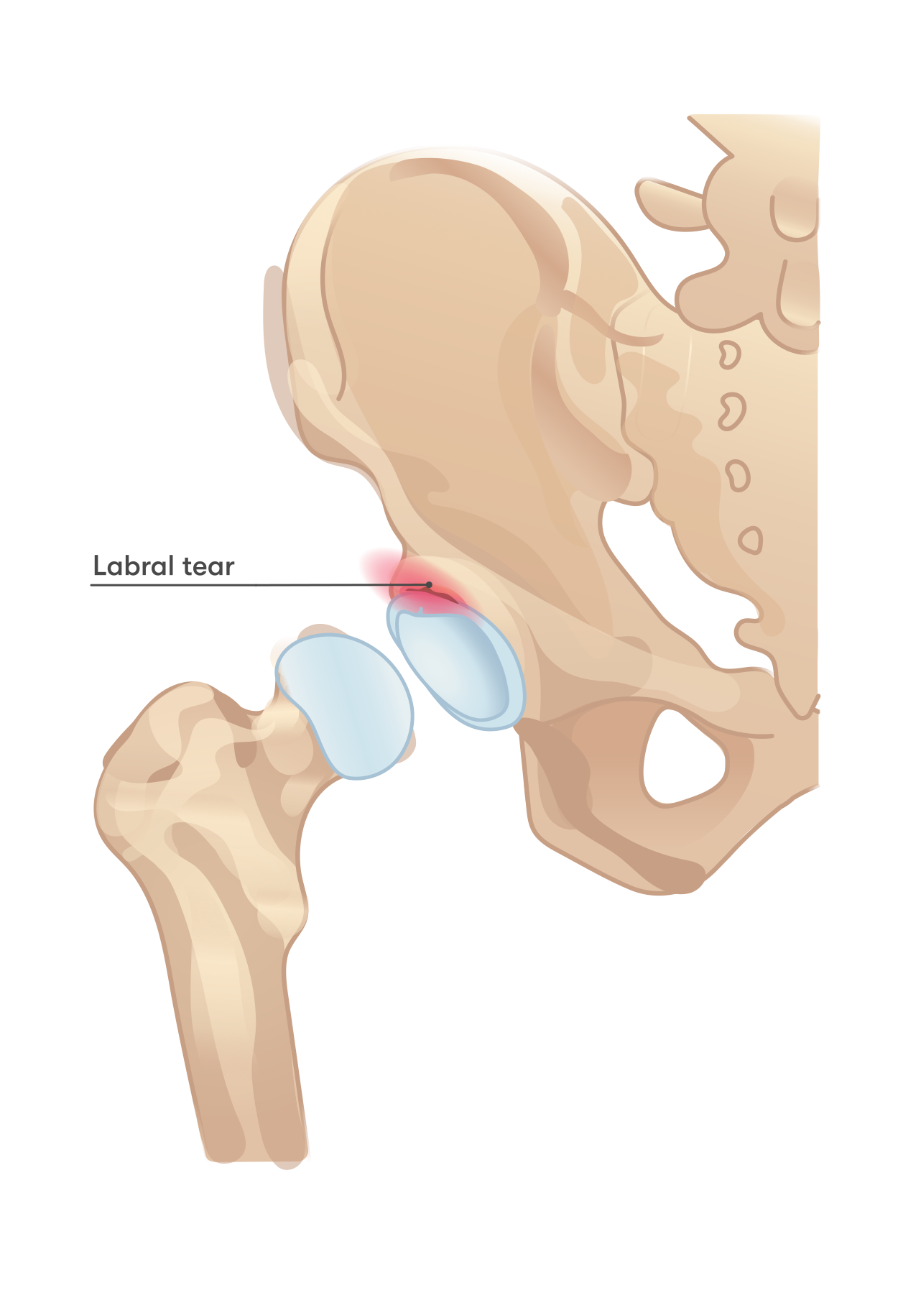
Simplified illustration of a hip labral tear.
Image and video credits
Labral tear 2 (opens in a new tab) — InjuryMap. CC BY-SA 4.0 (opens in a new tab).
Silent comparison of common FAI shapes.
Text description
The animation compares normal hip shape with cam, pincer, and combined impingement patterns.
Image and video credits
Three types of FAI (opens in a new tab) — Peter Krekel. CC BY-SA 4.0 (opens in a new tab). Modification: Transcoded from Ogg Theora to WebM VP9; no audio track; a poster frame was extracted and converted to JPEG for web delivery.
Common Symptoms
Patients often notice:
- Deep pain in the groin or front of the hip
- Pain that gets worse with sitting, squatting, pivoting, twisting, or sports
- Stiffness or loss of motion in the hip
- Clicking, catching, or a locking feeling
- Pain getting in and out of a car, low chair, or bed
- Limping or feeling less stable on that side
- Trouble with running, jumping, or cutting movements
Pain can sometimes also be felt in the outer hip, buttock, or thigh.
Causes and Risk Factors
FAI usually relates to the way the hip developed during growth. Symptoms may show up later, especially with activities that put the hip into deep bending and rotation.
Things that can increase the chance of symptoms include:
- Sports or activities with repeated hip flexion and twisting, such as hockey, soccer, dance, football, or golf
- Prior hip injury or dislocation
- Hip dysplasia or other childhood hip conditions
- High activity levels that repeatedly stress the joint
Activity can bring out symptoms, but it usually does not create the bone shape itself.
How Diagnosis Is Made
Diagnosis starts with your story and a physical exam. Your clinician will ask where the pain is, what motions trigger it, and whether you have clicking, catching, or stiffness. The hip is then moved in certain positions to see which motions reproduce symptoms.
Tests may include:
- X-rays: show the shape of the hip bones and whether arthritis is present
- MRI or MR arthrogram: looks for labral tears and cartilage damage
- CT scan: sometimes used when the bone shape needs closer detail, especially before surgery
- Diagnostic injection: numbing medicine placed in the joint can help confirm that the pain is coming from inside the hip
Imaging is only one part of the diagnosis. Labral tears and FAI changes can be seen even in people without pain, so the exam and your symptoms still matter.
Nonsurgical Treatment
Many people start with nonsurgical care, and many improve without surgery.
Common first steps include:
- Activity changes: temporarily avoiding deep squats, pivoting, or other motions that trigger pinching
- Pain relief: acetaminophen or an anti-inflammatory medicine such as an NSAID, if your clinician says it is safe for you
- Ice after flares: can help with soreness after activity
- Physical therapy: to improve hip movement, strengthen the hip and core, and reduce stress on the joint
- Injection: a corticosteroid injection may sometimes be used to calm pain or help confirm the source of symptoms
Physical therapy is usually targeted and gradual. The goal is not to force painful motion, but to improve strength, control, and movement patterns while avoiding positions that pinch the joint.
When Surgery May Be Discussed
Surgery may be discussed if:
- Pain continues despite a good trial of nonsurgical treatment
- Symptoms are limiting daily life, work, exercise, or sports
- You have ongoing catching or locking symptoms
- Imaging and exam findings match FAI and labral injury
The most common operation is hip arthroscopy, which uses small incisions and a camera. During surgery, the surgeon may:
- Repair the labrum
- Trim damaged tissue if repair is not possible
- Reshape the extra bone causing impingement
Some people with more severe bone changes may need a larger open procedure. If there is already significant arthritis in the joint, arthroscopy may be less helpful, and other options may be discussed.
Surgery can improve pain and function, but it does not guarantee a perfect hip or fully reverse cartilage damage that has already occurred.
Recovery and What to Expect
Recovery depends on how much damage is present, whether surgery is needed, and what activities you want to return to.
With nonsurgical care:
- Improvement often happens over weeks to a few months
- Symptoms may flare if activity increases too quickly
- Some patients do well long term with exercise and activity changes
After arthroscopic surgery:
- Most patients go home the same day
- Crutches are commonly used for a period of time
- Physical therapy usually starts early
- Daily activities often improve gradually over several weeks
- Full recovery takes several months
- Return to sports often takes about 3 to 6 months, sometimes longer for higher-demand sports
Some stiffness, soreness, and ups and downs during recovery are common. Improvement is usually gradual, not immediate.
When to Call the Office
Call your care team if:
- Pain is getting worse instead of better
- You keep having catching, locking, or giving-way episodes
- You are having trouble walking or doing normal daily activities
- Medicines are causing side effects
- Symptoms are not improving after following the treatment plan
- After surgery, you notice increasing redness, drainage, fever, or pain that is not controlled
When to Seek Urgent Help
Seek urgent medical care right away if you have:
- Sudden inability to put weight on the leg
- A major injury with severe hip pain or visible deformity
- New numbness, marked weakness, or loss of movement in the leg
- Fever with severe hip pain, redness, or rapid swelling
- After surgery, calf swelling or calf pain
- Chest pain, shortness of breath, or coughing up blood
Prevention and Protecting the Hip
You cannot always prevent FAI, but these steps may help reduce symptoms and protect the joint:
- Build up training gradually
- Warm up before sports or exercise
- Keep the hip and core muscles strong
- Avoid repeated deep painful positions when possible
- Get checked if groin or hip pain keeps coming back
Sources
References for further reading about this condition or procedure.
- Femoroacetabular Impingement (opens in a new tab)
American Academy of Orthopaedic Surgeons (AAOS), OrthoInfo
- Hip Arthroscopy (opens in a new tab)
American Academy of Orthopaedic Surgeons (AAOS), OrthoInfo