Malalignment & Angular Issues
Bowlegs and knock-knees change how weight passes through the knee.
Educational content only • Not a substitute for medical advice • For emergencies call 911
What this means
Knee alignment describes how the hip, knee, and ankle line up when you stand and walk. When the leg is angled, one side of the knee can carry more weight than the other. Over time, that extra stress can lead to pain and faster joint wear.
- Varus means the leg is more bow-legged. More pressure often goes through the inside of the knee.
- Valgus means the leg is more knock-kneed. More pressure often goes through the outside of the knee.
Some alignment differences are mild and do not need treatment. In children, mild bowing or knock-knees can be a normal part of growth. In adults, alignment problems are more often linked to arthritis, past injury, or the way the bones developed.
Anatomy and imaging
These illustrations and imaging examples can help you understand the anatomy. They do not show your diagnosis.
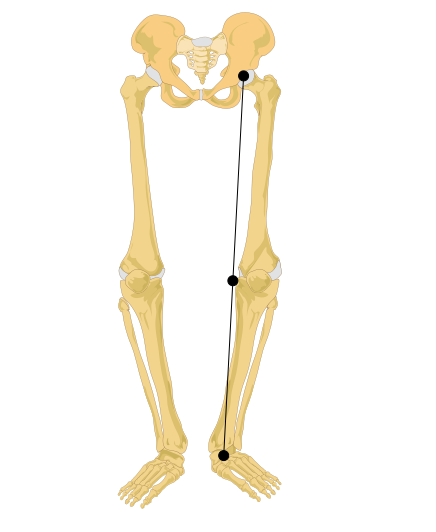
Simplified example of varus alignment.
Image and video credits
Genu varum (opens in a new tab) — LadyofHats, Jecowa, and Stündle. CC0 1.0 (opens in a new tab).
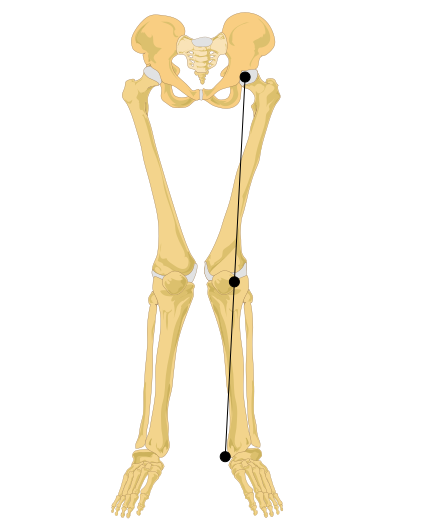
Simplified example of valgus alignment.
Image and video credits
Genu valgum (opens in a new tab) — LadyofHats, Jecowa, and Stündle. CC0 1.0 (opens in a new tab).
What patients may notice
- Legs that look bow-legged or knock-kneed
- Pain on the inner side of the knee with varus, or the outer side with valgus
- Stiffness, swelling, or aching with walking, stairs, or standing
- Feeling unsteady or like the knee may give way
- Trouble walking long distances
- A change in the way shoes wear down
- In children, legs that look more crooked over time, are different from side to side, or cause frequent tripping or pain
Common causes
- Normal growth patterns in young children that often improve with time
- Arthritis that wears down one side of the knee more than the other
- Old fractures, ligament injuries, infection, or growth plate problems
- Bone shape differences that developed during growth
- Less commonly, bone-softening problems such as vitamin D deficiency, rickets in children, or osteomalacia in adults
How doctors make the diagnosis
The diagnosis starts with your history and a physical exam. The clinician will usually ask about pain, walking limits, past injuries, and whether the alignment seems to be changing.
The exam often includes checking:
- How you stand and walk
- Knee motion and stability
- Where the knee is tender
- Whether one leg looks different from the other
- How the hip, knee, and ankle line up
Tests may include:
- Standing X-rays of the legs or knees to see how weight passes through the joint
- MRI or CT if there may be cartilage, meniscus, ligament, or bone-rotation problems, or if surgery is being planned
- Blood tests if a bone or vitamin problem is suspected
In children, age matters. Mild bow-legs are common in toddlers, and mild knock-knees are common in preschool-age children. If the shape is severe, worsening, painful, one-sided, or still present outside the expected age range, more evaluation is important.
Treatment without surgery
Nonsurgical care is usually tried first when symptoms are mild, arthritis is early, or a child may improve with growth.
Options may include:
- Observation and follow-up for children whose alignment may correct as they grow
- Physical therapy to strengthen the hip, thigh, and calf muscles and improve balance
- Low-impact exercise such as walking, cycling, swimming, or water exercise
- Weight management if needed to reduce stress on the knee
- Bracing to shift pressure away from the painful side of the joint
- Shoe inserts or orthotics in some cases to improve comfort or foot support
- Doctor-approved pain relief, such as medicines or, for some adults with arthritis, injections
- Treatment of the underlying cause, such as vitamin D replacement when a deficiency is found
These treatments often improve pain and function over weeks to months. In adults, they usually help symptoms more than they permanently change the bone position.
When surgery may be discussed
Surgery is not the first step for most people, but it may be discussed when:
- Pain is limiting daily life despite good nonsurgical care
- The deformity is getting worse
- One side of the knee is wearing out quickly
- A child has a severe or persistent deformity, especially if only one leg is affected
- The alignment problem is causing major trouble with walking or joint function
The type of surgery depends on age, cause, and how much arthritis is present.
- Guided growth may be used in children who are still growing. A small device is placed near the growth plate, the part of the bone that helps the leg grow, to gradually guide the leg into better alignment.
- Osteotomy means cutting and repositioning the bone to shift weight to a healthier part of the knee. This is often considered for younger or more active patients when the joint is not yet completely worn out.
- Knee replacement may be considered when arthritis is advanced and the joint surface is badly damaged.
Recovery and outlook
Recovery depends on the treatment.
With therapy, bracing, and activity changes, many people feel steadier and have less pain within several weeks to a few months.
After guided growth, correction happens gradually over months as the child grows. Regular follow-up visits and X-rays are important.
After an osteotomy, there is often a period of limited weight bearing, crutches, and physical therapy. Bone healing takes time. Many people improve over several months, and recovery can continue for 6 to 12 months.
After knee replacement, walking usually starts early, but strength, balance, and endurance improve more gradually over months. Many people return to daily activities within a few months, but high-impact activities may still be limited.
Even with good treatment, arthritis can still progress over time. Protecting the knee with exercise, weight management, and follow-up care remains important.
When to call the office
Call your care team if you notice:
- Pain or swelling that is getting worse instead of better
- A brace or shoe insert that causes skin irritation or does not fit well
- A child’s legs looking more uneven or more crooked over time
- New limping, frequent falls, or loss of knee motion
- Symptoms that are not improving with the current treatment plan
- Questions about activity, work, school, or recovery after surgery
When to seek urgent help
Seek urgent medical care right away for:
- Fever with a hot, red, swollen knee
- Calf pain or swelling
- Chest pain or sudden shortness of breath
- New numbness, weakness, or a cold or pale foot
- Inability to bear weight after an injury
- Severe pain that suddenly gets much worse
- A knee that locks and cannot be straightened
Sources
References for further reading about this condition or procedure.
- Osteotomy of the Knee (opens in a new tab)
American Academy of Orthopaedic Surgeons (AAOS), OrthoInfo