Gluteus Medius Tear
A gluteus medius tear affects a tendon on the outside of the hip that helps keep your pelvis steady when you walk.
Educational content only • Not a substitute for medical advice • For emergencies call 911
What It Is
A gluteus medius tear is a tear in one of the main tendons on the outside of the hip. You may also hear this called a hip abductor tendon tear.
The gluteus medius muscle helps lift the leg out to the side and keeps the pelvis level when you stand or walk. Its tendon attaches near the bony bump on the outside of the hip, called the greater trochanter. Some tears are small and partial. Others are full-thickness tears.
These tears can happen slowly from wear over time or more suddenly after a fall or twisting injury. A nearby fluid-filled sac, called a bursa, can also become irritated and add to the pain.
Anatomy and imaging
These illustrations and imaging examples can help you understand the anatomy. They do not show your diagnosis.
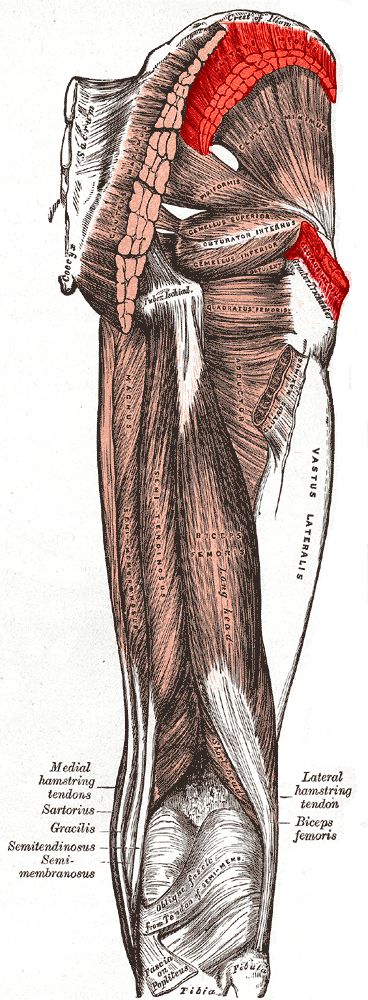
Location of the gluteus medius muscle and tendon region.
Image and video credits
Gluteus medius muscle (opens in a new tab) — Mikael Häggström. Public domain (opens in a new tab).
Common Symptoms
- Pain on the outside of the hip or upper buttock
- Pain that is worse with walking, stairs, hills, or standing on one leg
- Pain at night, especially when lying on the sore side
- Limping or feeling unsteady
- Weakness when lifting the leg out to the side
- Pain that may spread down the outside of the thigh
Why It Happens
- Gradual wear and tear of the tendon is the most common cause
- Risk is higher with repeated strain, a sudden increase in activity, a fall, or a twisting injury
- It is more common in middle-aged and older adults, especially women
- Nearby bursa irritation often happens at the same time
How It Is Diagnosed
Your clinician will ask about your pain, walking, sleep, daily activities, and any injury or fall. During the exam, they may press on the outside of the hip, check your strength, and watch how you stand or walk.
Imaging may include:
- X-rays to look for arthritis, fractures, or other bone problems
- Ultrasound to look at the tendon and sometimes guide an injection
- MRI to look more closely at the tendon, especially if symptoms are not improving or surgery is being considered
Other problems can feel similar, including hip bursitis, hip arthritis, and pain coming from the low back. Part of the visit is making sure the right problem is being treated.
Treatment Without Surgery
Most people start with nonsurgical treatment, especially if the tear is partial or the leg is still reasonably strong.
- Cut back for a time on activities that clearly flare pain, such as long walks, hills, running, or repeated stairs
- Use ice or heat if it helps comfort
- Take anti-inflammatory medicine or other pain medicine only if it is safe for you and your clinician says it is appropriate
- Start physical therapy to improve hip strength, balance, and the way you walk
- Avoid pressure on the sore side when possible; many people do better not lying on that side and using a pillow between the knees at night
- Use a cane or other walking aid for a short time if limping is significant; a cane is usually held on the opposite side
- A steroid injection around the irritated bursa may sometimes reduce pain, but it does not repair the torn tendon
When Surgery May Be Discussed
Surgery is not needed for everyone. It may be discussed when:
- Pain and limping remain significant after a good trial of nonsurgical care
- There is clear weakness or trouble walking normally
- Imaging shows a larger or full-thickness tear
- Daily activities, work, sleep, or exercise remain very limited
The goal of surgery is to reattach the torn tendon to the bone. Depending on the tear, this may be done through small incisions or through a more open incision.
Recovery Expectations
Recovery is usually gradual.
With nonsurgical care:
- Many people improve over 2 to 6 months, sometimes longer
- Pain may improve before strength fully returns
- Progress is often uneven, with good days and bad days
After surgery:
- Crutches and activity limits are common for the first several weeks
- Physical therapy usually continues for several months
- Meaningful improvement often takes months, and full recovery can take 6 to 12 months
Even with good treatment, some people continue to have occasional aching or weakness. Tell your care team if pain is getting worse instead of slowly improving.
When to Call the Office
Call your clinician promptly if:
- Pain is getting worse instead of better
- You are limping more or having more trouble with stairs or walking
- You cannot sleep because of hip pain despite following the treatment plan
- You develop new swelling, redness, warmth, fever, or chills
- You notice new numbness or new leg weakness
- You have questions about medicines, exercises, or activity limits
When to Seek Urgent Help
Seek urgent or emergency care if:
- You fall and cannot stand or put weight on the leg
- You have sudden severe hip pain with a major change in your ability to walk
- You have sudden loss of bowel or bladder control, especially with new leg weakness or numbness
- You have signs of a serious infection, such as high fever with rapidly spreading redness
Lowering Future Strain on the Hip
- Increase activity gradually rather than all at once
- Keep up hip and core strengthening once pain improves
- Use supportive footwear and be careful on uneven ground during painful flares
- Take breaks from activities that involve long periods of standing on one leg
- Ask your clinician or therapist when it is safe to return to higher-impact exercise
Sources
References for further reading about this condition or procedure.
- Hip Bursitis (opens in a new tab)
American Academy of Orthopaedic Surgeons (AAOS), OrthoInfo
- Hip Arthroscopy (opens in a new tab)
American Academy of Orthopaedic Surgeons (AAOS), OrthoInfo