Meniscus Tears
A meniscus tear affects one of the cushions of cartilage between the thighbone and shinbone.
Educational content only • Not a substitute for medical advice • For emergencies call 911
Overview
A meniscus tear is a tear in one of the two rubbery pads that cushion the knee. Each knee has one on the inner side and one on the outer side. These pads help absorb shock, spread weight, and add stability.
A tear can happen suddenly with a twist or pivot, or it can develop slowly over time as the tissue wears down. Many people call this a "torn cartilage" in the knee. A meniscus tear does not always mean surgery. Many people improve with time, activity changes, and physical therapy.
Anatomy and imaging
These illustrations and imaging examples can help you understand the anatomy. They do not show your diagnosis.
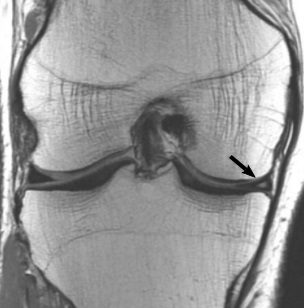
Example MRI appearance of a medial meniscus tear.
Image and video credits
Proton density MRI of a grade 2 medial meniscal tear (opens in a new tab) — Nicolas Lefevre, Jean Francois Naouri, Serge Herman, Antoine Gerometta, Shahnaz Klouche, and Yoann Bohu. CC BY 4.0 (opens in a new tab).
Common causes and risk factors
- Twisting or pivoting on a bent knee, especially with the foot planted
- Sports with cutting, turning, squatting, or contact
- Deep squatting, kneeling, or heavy lifting
- Age-related wear and tear
- Arthritis or a past knee injury
Symptoms patients often notice
- Pain along the inside or outside of the knee
- Swelling and stiffness, sometimes later the same day or the next day
- A pop at the time of injury
- Catching, clicking, or locking, meaning the knee feels stuck
- Trouble fully bending or straightening the knee
- A feeling that the knee may give way
- Pain with squatting, twisting, or getting up from a chair
How a meniscus tear is diagnosed
A clinician usually starts with your story, how the injury happened, and a knee exam. They check swelling, motion, tenderness along the knee joint, and whether certain movements reproduce pain or a click.
Tests may include:
- X-rays to look for fracture, arthritis, or other bone problems
- MRI to look at the meniscus and other soft tissues when the diagnosis is unclear, symptoms continue, the knee is locking, or surgery is being considered
- Arthroscopy, a small-camera procedure, sometimes if treatment is needed and the diagnosis still needs confirmation
Not everyone needs an MRI right away. In many cases, the exam and your symptoms are enough to guide early treatment.
Treatment without surgery
Many meniscus tears are treated without surgery at first, especially if the knee is not locked and symptoms are gradually improving.
Common nonsurgical treatment includes:
- Rest and activity changes to avoid twisting, pivoting, deep squats, and high-impact activity for a while
- Ice for 15 to 20 minutes at a time, several times a day, with a cloth between the ice and skin
- Compression and elevation to help with swelling
- Pain relief with acetaminophen or anti-inflammatory medicines such as ibuprofen or naproxen, if these are safe for you
- Crutches or a brace for a short time if walking is painful or the knee feels unstable
- Physical therapy to restore motion, strengthen the thigh and hip muscles, and improve balance and knee control
For age-related tears, physical therapy and time are often the main treatment. Improvement may take several weeks and sometimes a few months.
When surgery may be discussed
Surgery is usually considered when symptoms continue despite a good trial of nonsurgical care, or when the tear is unlikely to settle on its own.
Surgery may be discussed if:
- The knee locks and will not fully straighten
- Pain, swelling, or catching keeps coming back
- The tear is large, unstable, or causing repeated giving-way
- The tear happened with another knee injury, such as an ACL tear
- Your symptoms are limiting work, sports, or daily activity despite therapy
Common procedures include:
- Meniscus repair: the surgeon stitches the tear. This is more likely to work when the tear is near the outer edge, where blood supply is better.
- Partial meniscectomy: the surgeon trims only the torn, unstable part when the tear cannot be repaired.
When surgery is needed, surgeons usually try to save as much healthy meniscus as possible because the meniscus helps protect the knee over time.
Recovery and outlook
Recovery depends on the type of tear, whether arthritis is also present, the treatment used, and how well the knee regains motion and strength.
In general:
- Without surgery, many people improve enough for daily activities over weeks to a few months.
- After a partial meniscectomy, recovery is usually quicker and is often measured in weeks rather than many months, though return to sports may still take longer.
- After a meniscus repair, recovery is slower because the tissue has to heal. Crutches or a brace may be needed at first, and return to full activity often takes several months and may be around 6 months.
Mild soreness or swelling can come and go during recovery, especially after more activity. Return to sports or heavy work should be based on pain, swelling, strength, balance, and guidance from your care team, not just time on the calendar. If part of the meniscus has to be removed, that can increase wear on the knee over time and may raise the chance of arthritis later.
When to call the office
Call your care team if:
- Pain or swelling is getting worse instead of better
- The knee keeps catching, locking, or giving way
- You cannot fully bend or straighten the knee after the early swelling settles
- You are still limping or having trouble with stairs or daily activity after rest and home care
- After surgery, you have redness, drainage, fever, or pain that is not improving as expected
When to seek urgent help
Seek urgent medical care if:
- You cannot bear weight after the injury
- The knee looks deformed or out of place
- The knee locks and you cannot straighten it
- You have numbness, tingling, or a cold foot
- The knee is very swollen, hot, and red, or you have fever and feel unwell
- After surgery, you develop calf swelling or pain, or sudden shortness of breath
Prevention and daily habits
- Build strength in the thighs, hips, and core
- Warm up before sports or exercise
- Increase activity gradually rather than all at once
- Use good form with lifting, squatting, and pivoting
- Wear supportive footwear for your activity
Sources
References for further reading about this condition or procedure.
- Meniscus Tears (opens in a new tab)
American Academy of Orthopaedic Surgeons (AAOS), OrthoInfo
- Meniscus Repair (opens in a new tab)
American Academy of Orthopaedic Surgeons (AAOS), OrthoInfo