Shoulder Arthritis
Shoulder arthritis damages the cartilage that allows the joint to move smoothly.
Educational content only • Not a substitute for medical advice • For emergencies call 911
What Is Shoulder Arthritis?
Shoulder arthritis means the smooth joint surface in the shoulder has worn down or become damaged. The main shoulder joint is a ball-and-socket joint. The ball is the top of the arm bone, and the socket is part of the shoulder blade.
In a healthy shoulder, cartilage covers the joint surfaces so the bones glide smoothly. With arthritis, that cartilage becomes thin or rough. The joint can become painful, stiff, and harder to move.
The most common type is osteoarthritis, which is related to wear over time. Shoulder arthritis can also happen after an injury, with inflammatory arthritis such as rheumatoid arthritis, or after a large rotator cuff tear.
Anatomy and imaging
These illustrations and imaging examples can help you understand the anatomy. They do not show your diagnosis.
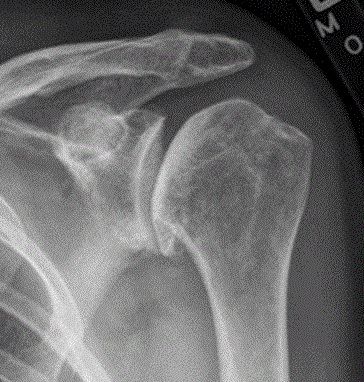
Example shoulder X-ray showing osteoarthritis.
Image and video credits
X-ray of osteoarthritis of the shoulder (opens in a new tab) — Vladimir V. Senatorov, Ramon Cuevas-Trisan, Francisco J. Garcia, Gabriel P. Suciu, Robert H. Parkes, and Alina M. Alonso. CC BY 4.0 (opens in a new tab).
Symptoms Patients Often Notice
Common symptoms include:
- A deep ache in the shoulder
- Pain with reaching overhead, behind your back, or across your body
- Stiffness, especially after rest
- Grinding, popping, or catching with movement
- Pain at night or trouble sleeping on that side
- Weakness or loss of motion
- Difficulty with daily tasks such as dressing, washing hair, fastening a seat belt, or lifting items
Symptoms often come on gradually, but they can flare up after heavier use.
What Can Cause It?
Things that may raise the risk include:
- Aging and long-term wear of the joint
- A past shoulder injury, such as a fracture or dislocation
- A large rotator cuff tear
- Inflammatory arthritis, such as rheumatoid arthritis or psoriatic arthritis
- Prior shoulder surgery in some cases
How It Is Diagnosed
Your clinician usually makes the diagnosis using:
- Your symptoms and medical history
- A physical exam to check motion, strength, and pain with movement
- X-rays, which are often the first imaging test
X-rays can show narrowing of the joint space, bone spurs, changes in bone shape, or signs that the joint is no longer lining up normally.
Sometimes other tests are needed:
- CT scan for more detail about the bone
- MRI to look at the rotator cuff and other soft tissues
- Blood tests if inflammatory arthritis or infection is a concern
Nonsurgical Treatment
Many people start with nonsurgical care. The goals are to reduce pain, keep the shoulder moving, and make daily activities easier.
Common treatments include:
- Activity changes, especially avoiding repeated heavy lifting or painful overhead work
- Heat before activity or stretching, and ice after activity if the shoulder is sore
- Pain medicines such as acetaminophen or anti-inflammatory medicines, if safe for you
- Cortisone injections in some cases for temporary pain relief
- Physical therapy or a home exercise program to maintain motion and strengthen the muscles around the shoulder
- Sleep adjustments, such as using a pillow to support the arm or sleeping slightly upright
- General exercise like walking or stationary cycling to stay active without overloading the shoulder
These treatments do not reverse arthritis, but they can help control symptoms for a long time.
When Surgery May Be Discussed
Surgery may be discussed when:
- Pain remains severe despite nonsurgical treatment
- Sleep is regularly disrupted by shoulder pain
- Daily tasks have become very difficult
- The shoulder is becoming much stiffer or weaker
- Imaging shows advanced joint damage
The most common surgery for advanced shoulder arthritis is shoulder replacement.
Types of surgery may include:
- Total shoulder replacement, which replaces the ball and socket
- Reverse shoulder replacement, often used when the rotator cuff is badly torn or cannot do its job well
- Other procedures in selected cases, depending on the cause of the arthritis and the condition of the joint
Your surgeon will choose the option that best matches the joint damage, your rotator cuff, and your goals.
Recovery and What to Expect
If You Do Not Have Surgery
Shoulder arthritis is usually a long-term condition. Symptoms may come and go. Many people are able to manage pain and stay active with exercise, medication, injections, and activity changes.
If You Have Shoulder Replacement Surgery
Recovery takes time. Most people notice pain relief first, then gradual improvement in movement and function.
In general:
- A sling is often used for a period of time after surgery
- Physical therapy usually starts early and continues for several weeks or months
- Light daily activities often improve within weeks
- Strength and motion usually improve more slowly over several months
- Improvement can continue for 6 to 12 months
The main goal of surgery is usually pain relief and better function for everyday life. Even after a successful replacement, heavy lifting or repeated overhead work may still be limited.
When To Call the Office
Call your care team if:
- Shoulder pain is getting worse instead of better
- You are losing more motion or function
- Medicines or exercises are no longer helping
- You have new numbness, tingling, or weakness
- You have questions about whether an injection, therapy, or surgery evaluation is the next step
When To Seek Urgent Care
Seek urgent medical care right away if you have:
- Sudden severe shoulder pain after a fall or injury
- A shoulder that looks out of place or cannot be moved
- Fever with a hot, red, very swollen shoulder
- New major weakness or inability to lift the arm
- Severe numbness, or a hand that becomes pale, cold, or blue
- After an injection or surgery: drainage, spreading redness, fever, or a sudden major increase in pain
Living With Shoulder Arthritis
These steps may help protect the joint and reduce flare-ups:
- Keep the shoulder moving with gentle exercises
- Avoid letting the shoulder become completely inactive for long periods
- Use good posture during desk work and daily activities
- Break up tasks that involve lifting or reaching
- Ask for help with heavy overhead items
Sources
References for further reading about this condition or procedure.
- Arthritis of the Shoulder (opens in a new tab)
American Academy of Orthopaedic Surgeons (AAOS), OrthoInfo
- Shoulder Joint Replacement (opens in a new tab)
American Academy of Orthopaedic Surgeons (AAOS), OrthoInfo