Anterior Cruciate Ligament (ACL) Tear
An ACL tear injures a ligament that helps keep the knee stable during turning and pivoting.
Educational content only • Not a substitute for medical advice • For emergencies call 911
What It Is
The anterior cruciate ligament, or ACL, is one of the main ligaments inside the knee. Ligaments are strong bands of tissue that connect bones. The ACL helps keep the shinbone from sliding too far forward and helps control twisting.
An ACL tear happens when this ligament is stretched too far or tears. This often happens during sports with sudden stopping, pivoting, cutting, or awkward landing from a jump. It can also happen from a fall, car crash, or another direct injury to the knee.
ACL tears can be partial or complete. Not every ACL tear needs surgery. The best treatment depends on how unstable the knee feels, whether there are other knee injuries, and what activities a person wants or needs to return to.
Anatomy and imaging
These illustrations and imaging examples can help you understand the anatomy. They do not show your diagnosis.
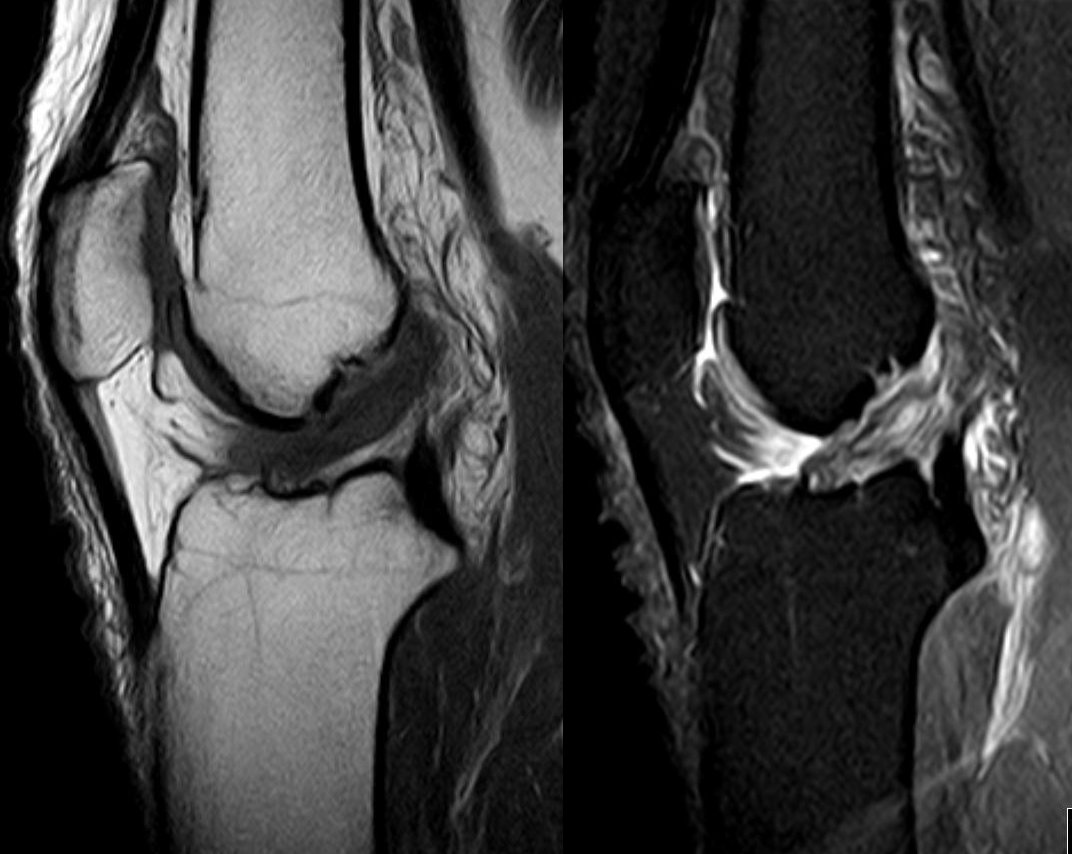
Example MRI appearance of an ACL tear.
Image and video credits
VKB-Riss MRT T1 PDW sag (opens in a new tab) — Hellerhoff. CC BY-SA 3.0 (opens in a new tab).
Common Symptoms
Patients often notice:
- A popping sound or popping feeling at the time of injury
- Pain and swelling that come on quickly, often within a few hours
- Trouble walking, bending, or fully straightening the knee
- A feeling that the knee is loose, wobbly, or may give way
- Less confidence in the knee, especially with turning or pivoting
Some people can still walk after an ACL tear, so being able to walk does not rule it out.
How It Is Diagnosed
A clinician usually diagnoses an ACL tear with:
- A history of how the injury happened
- A knee exam, including gentle hands-on tests to see whether the shinbone moves too far
- X-rays to check for broken bones or a piece of bone pulled off by the ligament
- MRI to confirm the tear and look for other injuries, such as meniscus, cartilage, or other ligament damage
Sometimes the knee is too swollen or painful to examine well at first, so part of the exam may be repeated after the swelling starts to improve.
Early Care After the Injury
Early treatment usually focuses on calming the knee down and protecting it:
- Stop the activity
- Rest the knee
- Ice the knee for short periods
- Use compression and elevation if recommended
- Use crutches or a brace if recommended
- Avoid sports or twisting activities until you have been evaluated
Pain medicine may also be used if your clinician says it is appropriate.
Nonsurgical Treatment
Nonsurgical care may be a good option for:
- Some partial ACL tears
- People whose knee feels stable during normal daily activities
- People who do not need pivoting or cutting sports for work or recreation
- People who prefer to try rehabilitation first
Nonsurgical treatment often includes:
- Physical therapy to reduce swelling and restore motion
- Strengthening of the thigh, hip, and core muscles
- Balance and movement training to improve knee control
- Activity changes to avoid motions that make the knee give way
- A brace in some cases
The goals are to reduce pain and swelling, regain motion, rebuild strength, and help the person return safely to daily activities. Some people do very well without surgery, especially if the knee does not keep giving way.
When Surgery May Be Discussed
Surgery is more likely to be discussed when:
- The ACL is completely torn
- The knee repeatedly gives way
- The person wants to return to sports or work that involve pivoting, cutting, jumping, or quick direction changes
- There are related injuries, such as a meniscus tear or other ligament injury
- A good course of therapy does not provide enough stability
Most ACL surgeries are reconstructions, not repairs. This means the torn ligament is usually replaced with a graft, which is tissue taken from the patient or from a donor. Surgery is commonly done with arthroscopy, which uses small incisions and a camera.
Surgery can improve knee stability, but recovery still depends heavily on rehabilitation.
Recovery and What to Expect
Recovery takes time, whether treatment is surgical or nonsurgical.
Common recovery milestones include:
- In the first few weeks, reducing swelling and regaining the ability to fully straighten the knee
- Walking without a limp as strength and comfort improve
- Building strength, balance, and confidence over the next several months
- Returning to running before returning to jumping, cutting, or pivoting
- Returning to sports only after meeting strength, motion, and movement goals, not just after waiting a certain number of months
After ACL reconstruction, return to cutting or pivoting sports often takes about 9 to 12 months or longer. Some people need more time. Even without surgery, it may take months to regain strength and confidence.
An ACL injury can also increase the risk of future knee problems, including another ACL injury and arthritis later in life, especially if there is also meniscus or cartilage damage.
When to Seek Urgent Help
Get urgent medical care right away if:
- The knee looks badly deformed
- You cannot bear weight after a major injury
- Your foot becomes cold, pale, blue, or numb
- You have severe calf pain or swelling
- You have chest pain or sudden shortness of breath
When to Call the Office
Call your orthopedic office or clinician if:
- Pain, swelling, or stiffness is getting worse instead of better
- The knee catches, locks, or gives way again
- You cannot fully bend or straighten the knee
- You are not making progress in therapy
- You need guidance about returning to work, school, exercise, or sports
After surgery, call the office if you have:
- Fever
- Increasing redness, drainage, or worsening pain around an incision
- New numbness or worsening swelling that concerns you
Lowering the Chance of Another Injury
To lower the chance of another knee injury:
- Keep up with home exercises and physical therapy
- Build hip, thigh, and core strength
- Practice safe jumping and landing mechanics
- Return to activity gradually
- Ask about ACL injury-prevention programs if you play sports
Sources
References for further reading about this condition or procedure.
- ACL Injury: Does It Require Surgery? (opens in a new tab)
American Academy of Orthopaedic Surgeons (AAOS), OrthoInfo
- Plain Language Summary: The Management of Anterior Cruciate Ligament Injuries (opens in a new tab)
American Academy of Orthopaedic Surgeons (AAOS), OrthoInfo