Hip Dysplasia
Hip dysplasia means the socket does not cover enough of the ball of the hip joint.
Educational content only • Not a substitute for medical advice • For emergencies call 911
Overview
Hip dysplasia means the hip socket is too shallow or shaped in a way that does not fully cover the ball of the hip joint. Because the ball is not supported as well as it should be, the hip can be loose, partly slip out of place, or sometimes fully dislocate. It can affect one or both hips.
In babies, this is often called developmental dysplasia of the hip (DDH). Many cases are found in infancy during routine exams. Some mild cases are not noticed until the teen or adult years, when they can cause pain, catching, or early arthritis.
Anatomy and imaging
These illustrations and imaging examples can help you understand the anatomy. They do not show your diagnosis.
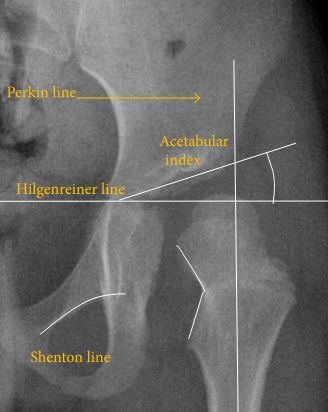
Example measurements used when evaluating hip dysplasia.
Image and video credits
X-ray of measurements in hip dysplasia (opens in a new tab) — Fernando Ruiz Santiago, Alicia Santiago Chinchilla, Afshin Ansari, Luis Guzmán Álvarez, Maria del Mar Castellano García, Alberto Martínez Martínez, and Juan Tercedor Sánchez. CC BY 4.0 (opens in a new tab).
How It Affects the Hip
The hip is a ball-and-socket joint. In hip dysplasia, the socket does not support the ball well. This puts extra stress on the edge of the socket, the labrum (the ring of cartilage around the socket), and the smooth cartilage inside the joint.
Over time, that extra stress can lead to pain, labral tears, and early wear of the joint.
Who Is More Likely to Have It?
- Family history of hip dysplasia
- Female sex
- Breech position before birth
- Firstborn babies
- Low amniotic fluid during pregnancy
- Tight swaddling with the hips and knees held straight
In teens and adults, hip dysplasia often started earlier in life but was mild or was not recognized at the time.
Symptoms
Babies and Young Children
- Often no pain
- One hip that feels loose on exam
- One leg that seems shorter
- Limited ability to spread the legs apart
- Uneven thigh or buttock folds
- A limp, waddling walk, or toe-walking on one side after walking begins
Teens and Adults
- Pain in the groin, front of the hip, side of the hip, or buttock
- Pain that is worse with sports, long walks, stairs, or prolonged sitting
- A catching, clicking, or popping feeling
- A sense that the hip is giving way or unstable
- Limping or decreased endurance
Symptoms may start slowly and become more noticeable over time.
How Diagnosis Is Made
A clinician starts with a history and a physical exam. In babies, the hips are checked at newborn visits and well-child visits. In older children and adults, the exam focuses on motion, gait, strength, and positions that reproduce pain.
Imaging helps confirm the diagnosis:
- Ultrasound is most useful in young infants.
- X-rays are more useful after the hip bones have matured enough to show the socket clearly.
- MRI may be used to look for labral or cartilage damage.
- CT is sometimes used for detailed bone measurements and surgical planning.
Nonsurgical Treatment
Treatment depends on age, symptoms, and how unstable the hip is.
Babies
- A Pavlik harness or similar brace is often the first treatment when hip dysplasia is found early.
- The harness keeps the hips in a position that helps the joint develop more normally.
- Regular follow-up visits are important to check hip position and fit of the harness.
Older Children, Teens, and Adults
- Activity changes to avoid motions that flare pain
- Physical therapy to improve strength, motion, and walking mechanics
- Pain medicine such as acetaminophen or NSAIDs, if a clinician says these are safe
- Weight management if advised, to reduce stress on the joint
- Sometimes an injection for temporary pain relief in older patients
Nonsurgical care can improve symptoms, but it does not change the shape of a shallow socket in a teen or adult.
When Surgery May Be Discussed
Surgery may be discussed when:
- The hip stays out of place or remains unstable
- A brace is not enough
- The condition is found later, when the bones are less flexible
- Pain, limping, or loss of function continue despite nonsurgical care
- Imaging shows joint damage but the hip is still worth preserving
Possible procedures include:
- Closed reduction or open reduction in infants and young children to place the ball back in the socket
- A spica cast after reduction to hold the hip in position while it heals
- Femoral or pelvic osteotomy to improve alignment in children
- Periacetabular osteotomy (PAO) in adolescents and young adults to reposition the socket
- Hip arthroscopy in select cases to treat a labral tear, usually as an addition to other treatment rather than the main fix for significant dysplasia
- Total hip replacement when arthritis is advanced and joint-preserving surgery is not likely to help
Recovery and Outlook
When hip dysplasia is found early in babies, treatment is often very successful. Even after early treatment, follow-up exams and X-rays may continue as a child grows to make sure the hip develops well.
Recovery depends on the treatment:
- Harness treatment usually lasts weeks to a few months.
- After a closed or open reduction, a spica cast may be needed for several weeks to months.
- After PAO, most people stay in the hospital a few days, use crutches for about 6 to 12 weeks, and build strength gradually with physical therapy.
- Return to running or sports after PAO often takes many months. Full recovery can take 6 to 12 months.
- If hip replacement is needed later in life, pain usually improves, but recovery still takes several months and the artificial joint does not last forever.
Many people do well after treatment, but some develop stiffness, persistent pain, or arthritis over time.
When to Call the Office
Call your care team if:
- A brace or harness seems too tight, causes skin sores, or is hard to use safely
- Your baby is not moving one leg normally, or the foot looks swollen, pale, or cool
- Pain, limp, or catching symptoms are getting worse
- Your child or teen is having more trouble with walking, sports, or daily activities
- After surgery, there is fever, redness, drainage, or a bad smell from the incision
- Recovery is not going as expected
When to Seek Urgent Help
Seek urgent care right away if:
- There is sudden severe hip pain or the person cannot bear weight
- The leg looks deformed or the hip seems out of place
- There is new numbness, weakness, or loss of movement in the leg or foot
- After surgery, there is calf swelling or pain, chest pain, or shortness of breath
Prevention and Daily Tips
- Make sure newborns have routine hip screening visits.
- If you swaddle a baby, leave room for the hips and knees to stay bent and move freely.
- Seek evaluation for a lasting limp, groin pain, or repeated hip catching.
- Keep follow-up visits, even if symptoms seem mild, because hip shape can change as a child grows.
Sources
References for further reading about this condition or procedure.
- Treatment Overview (opens in a new tab)
International Hip Dysplasia Institute
- Adolescent Hip Dysplasia (opens in a new tab)
American Academy of Orthopaedic Surgeons (AAOS), OrthoInfo