ACL Reconstruction
ACL reconstruction replaces a torn knee ligament with a tendon graft.
Educational content only • Not a substitute for medical advice • For emergencies call 911
What This Surgery Is
The ACL is one of the main ligaments that helps keep the knee stable, especially with twisting, pivoting, and sudden stops. When the ACL tears, the knee may feel loose or give way.
ACL reconstruction means rebuilding the torn ligament with a graft. The graft may come from your own tissue (autograft) or donor tissue (allograft). In many ACL tears, the ligament does not heal well enough on its own to restore normal knee stability.
Anatomy and imaging
These illustrations and imaging examples can help you understand the anatomy. They do not show your diagnosis.
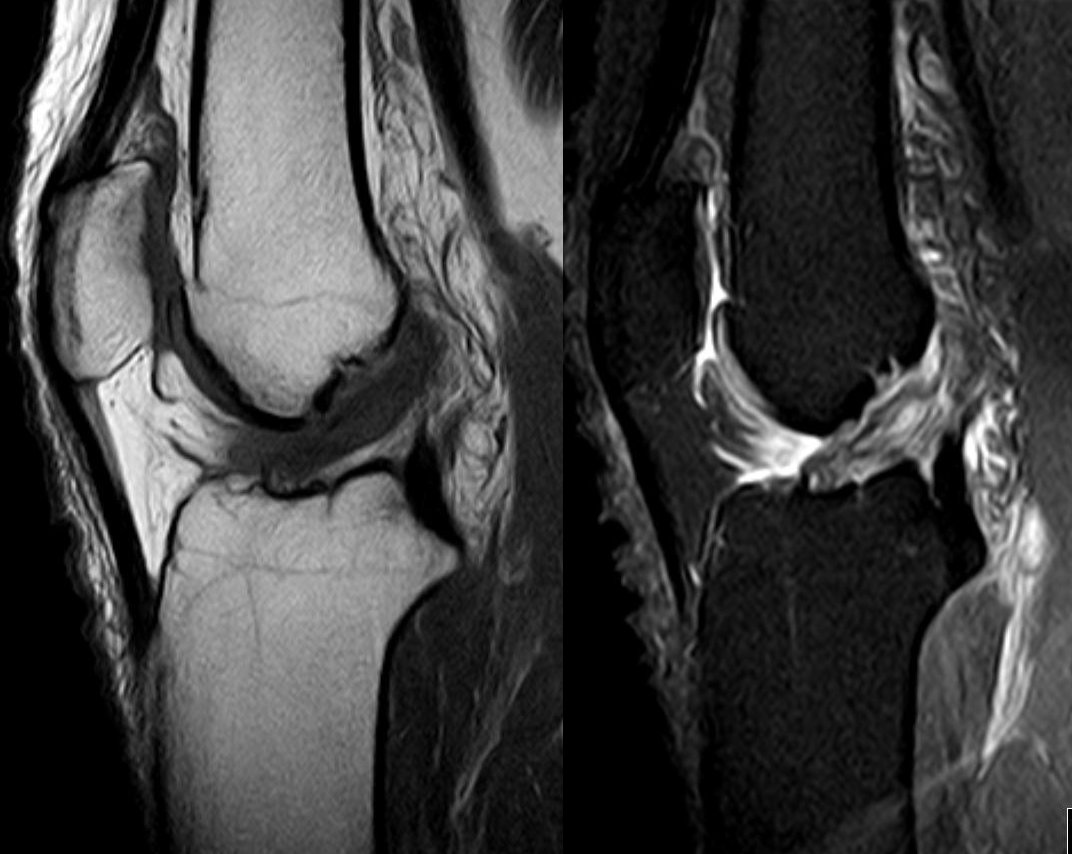
Example MRI appearance of an ACL tear.
Image and video credits
VKB-Riss MRT T1 PDW sag (opens in a new tab) — Hellerhoff. CC BY-SA 3.0 (opens in a new tab).
Why It May Be Recommended
ACL reconstruction may be recommended if:
- your knee keeps giving way even after physical therapy and strengthening
- you want to return to sports or work that involve pivoting, cutting, jumping, or quick direction changes
- you have other knee injuries that may need treatment at the same time, such as a meniscus tear
- knee instability is affecting daily activities
Not everyone with an ACL tear needs surgery. Some people do well with rehabilitation, activity changes, and sometimes a brace. Your surgeon will weigh your symptoms, exam, imaging, age, activity goals, and any other knee injuries.
Surgery is often planned after swelling has improved and the knee has regained some motion. This can lower the chance of significant stiffness after surgery.
Before Surgery
Your care team will give you instructions that are specific to your surgery. Common steps include:
- following instructions about when to stop eating and drinking
- asking which medicines or supplements to stop or continue, especially blood thinners, diabetes medicines, and anti-inflammatory medicines
- arranging a ride home and help for the first day or two
- preparing crutches, ice, loose clothing, and a safe place to rest at home
- knowing when home exercises or physical therapy should start
It is also reasonable to ask your surgeon which graft they recommend and why.
What Happens During the Procedure
ACL reconstruction is usually done with arthroscopy. This means the surgeon uses a camera and small incisions rather than one large incision.
At a high level, the surgery usually includes:
- anesthesia, sometimes with a nerve block, which is a numbing injection to help with pain after surgery
- a small camera to inspect the knee joint
- treatment of other problems found at the same time, such as meniscus or cartilage injuries
- removal of the torn ACL and creation of small bone tunnels in the thighbone and shinbone
- placement of the graft where the old ACL used to be
- securing the graft with buttons, screws, or similar devices
- closing the incisions and placing a dressing, and sometimes a brace
Most patients go home the same day. The operation often takes about 1 to 2 hours, but timing varies.
Right After Surgery
It is common to have:
- pain, swelling, bruising, and stiffness
- soreness when bending or straightening the knee
- a brace and crutches for a period of time
- a small numb area near an incision
- tiredness or nausea for a day or two after anesthesia
Your surgeon will tell you how much weight you can put on the leg. Some patients can put weight on it right away, while others need more protection, especially if a meniscus repair was also done.
Ice, elevation, ankle pumps, and early gentle motion are often part of the first few days. Physical therapy usually starts early to help restore motion, walking, strength, and balance.
Recovery and Return to Activity
Recovery takes time. The graft also needs time to heal into the bone and mature.
Typical ranges are:
- return to basic daily activities with support: the first few days to weeks
- return to desk work or school: often about 1 to 2 weeks
- return to more physical jobs: often several weeks or longer
- driving: only when you are off strong prescription pain medicine and can safely control the leg; right knee surgery often takes longer
- jogging or straight-line running: often around 3 to 5 months if healing and strength are on track
- return to pivoting or contact sports: often about 9 to 12 months, and sometimes longer
These are general ranges, not guarantees. Recovery may be slower if you had additional repairs, had major swelling or stiffness before surgery, or need more time to rebuild strength and movement control.
Risks and Possible Complications
Possible risks include:
- infection
- bleeding or ongoing drainage
- blood clots in the leg
- knee stiffness or loss of motion
- ongoing pain or swelling
- a numb patch near the incision
- pain where the graft was taken if your own tissue is used
- the graft stretching out or tearing again
- the knee still feeling unstable
- irritation from hardware or need for another surgery
- risks related to anesthesia
Most patients do well, but no surgery can guarantee a perfect result or prevent future knee injury.
When to Call the Office
Call your surgical team promptly if you have:
- fever over 101 F (38.3 C)
- increasing redness, warmth, pus, bad-smelling drainage, or opening of the incision
- swelling or pain that is getting worse instead of better
- calf pain, calf swelling, or new tenderness in the lower leg
- new numbness, weakness, or trouble moving the foot or toes
- severe pain not controlled by the prescribed plan
- repeated vomiting, dehydration, or trouble taking medicines
- questions about your brace, dressing, or weight-bearing instructions
When to Seek Urgent Care
Seek urgent or emergency care right away for:
- chest pain
- trouble breathing
- sudden shortness of breath
- coughing up blood
- a foot that becomes cold, pale, blue, or suddenly very numb
- heavy bleeding that does not stop
Common Questions Before Surgery
- Will the surgeon repair the torn ACL or replace it? In many cases, the ACL is reconstructed, which means replaced with a graft. A simple stitch repair is not the standard approach for many tears.
- Which graft is best? There is no single best graft for every patient. The choice depends on age, activity level, prior surgery, sport or work demands, and surgeon judgment.
- What if I do not have surgery? Some people can manage an ACL tear without surgery through rehabilitation and activity changes. Others continue to have knee instability.
- Will I go home the same day? Usually yes. Some patients stay longer if they have other injuries, other medical needs, or more complex surgery.
- How much help will I need at home? Most people do best if someone can drive them home and stay with them at least the first night.
- When will therapy start? Many patients start home exercises right away and formal physical therapy within a few days, but your plan may differ.
- When can I shower? Follow your surgeon's instructions. You may need to keep the dressing and incision dry until you are told it is safe.
- How long until I feel normal? Swelling and stiffness can last for weeks, and full recovery commonly takes many months.
- What if my knee is still very swollen or hard to straighten before surgery? Surgery is sometimes delayed until motion improves, because operating on a very stiff knee can increase the risk of a stiff knee afterward.
Dr. Rizzo’s physical therapy protocols
These are my own rehabilitation protocols. Your operation, graft, and any additional repairs determine which one applies.
ACL Reconstruction With Allograft Protocol
Use only when your discharge instructions identify a donor-tissue graft (allograft).
Open protocol PDF (opens in a new tab)ACL Reconstruction With BTB Autograft Protocol
Use only when your discharge instructions identify a bone-patellar tendon-bone (BTB) graft from your own knee.
Open protocol PDF (opens in a new tab)ACL Reconstruction With Quadriceps Autograft Protocol
Use only when your discharge instructions identify a quadriceps tendon graft from your own thigh.
Open protocol PDF (opens in a new tab)Revision ACL Reconstruction With BTB Autograft Protocol
Use only after revision ACL reconstruction when your discharge instructions specifically identify a BTB autograft.
Open protocol PDF (opens in a new tab)Sources
References for further reading about this condition or procedure.
- ACL Injury: Does It Require Surgery? (opens in a new tab)
American Academy of Orthopaedic Surgeons (AAOS), OrthoInfo
- Plain Language Summary: The Management of Anterior Cruciate Ligament Injuries (opens in a new tab)
American Academy of Orthopaedic Surgeons (AAOS), OrthoInfo