Meniscus Repair or Meniscectomy
Meniscus surgery may repair a tear, remove an unstable portion, or replace missing meniscus tissue in selected cases.
Educational content only • Not a substitute for medical advice • For emergencies call 911
What the meniscus is
The meniscus is a C-shaped pad of cartilage in the knee. Each knee has two menisci. They help cushion the joint, spread out force, and add stability.
A meniscus tear can happen after a twist, pivot, deep squat, or sports injury. It can also happen slowly over time from wear and tear.
Anatomy and imaging
These illustrations and imaging examples can help you understand the anatomy. They do not show your diagnosis.
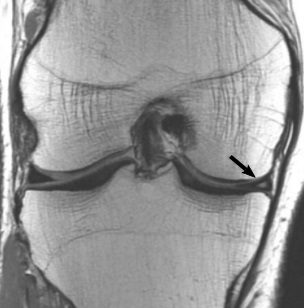
Example MRI appearance of a medial meniscus tear.
Image and video credits
Proton density MRI of a grade 2 medial meniscal tear (opens in a new tab) — Nicolas Lefevre, Jean Francois Naouri, Serge Herman, Antoine Gerometta, Shahnaz Klouche, and Yoann Bohu. CC BY 4.0 (opens in a new tab).
Why surgery may be recommended
Not every meniscus tear needs surgery. Many people improve with time, activity changes, physical therapy, ice, and medicines.
Surgery may be recommended when:
- knee pain, swelling, catching, or locking keeps coming back
- the knee cannot move smoothly because of the tear
- symptoms have not improved enough with non-surgical care
- the tear pattern looks unlikely to heal on its own
- the surgeon believes repair is possible and may protect the knee better long term
Meniscus surgery often helps symptoms caused by the torn meniscus itself. It may help less if most of the pain is coming from arthritis already present in the knee.
The main types of meniscus surgery
Partial meniscectomy
In a partial meniscectomy, the surgeon removes only the torn and unstable part of the meniscus and leaves as much healthy tissue as possible.
This is more commonly used when:
- the tear is in a part of the meniscus with poor blood supply
- the tear is frayed, complex, or worn out
- the tissue is unlikely to heal even if it is stitched
This procedure often improves catching or locking more quickly than a repair, but removing meniscus tissue can increase long-term wear in the knee.
Meniscus repair
In a meniscus repair, the surgeon stitches the torn edges together so the meniscus can heal.
This is more likely to be considered when:
- the tear is in a part of the meniscus with better blood supply
- the tear pattern is one that can be stitched back together
- the tissue quality is good enough to heal
A repair keeps more of the natural meniscus in place, which is good for knee cushioning and stability. The tradeoff is a slower recovery because the repair needs time to heal.
A less common option: meniscus transplant
A meniscus transplant is a different surgery for selected people who have already lost most or all of a meniscus and still have pain. It is not the usual treatment for a new meniscus tear. If this applies to you, your surgeon will discuss it separately.
What happens during surgery
Most meniscus surgeries are done as outpatient procedures, which means you usually go home the same day.
At a high level, surgery usually involves:
- anesthesia, so you are asleep or the leg is numb and you are comfortable
- a few small cuts around the knee
- arthroscopy, which means a small camera and small tools are used inside the joint
- trimming the torn piece or stitching the tear, depending on what is safest and most likely to help
- closing the small cuts with stitches, tape strips, or surgical glue
- placing a bandage, and sometimes a brace
Sometimes the final decision between trimming and repair is made during surgery, after the surgeon sees the tear directly.
Recovery and return to activity
Recovery depends a lot on which procedure you have.
Right after surgery
It is normal to have:
- knee soreness
- swelling
- stiffness
- some trouble walking at first
Early care often includes:
- ice
- elevation
- pain medicine as directed
- crutches for comfort or protection
- gentle exercises
- physical therapy, if your surgeon recommends it
Usual recovery ranges
After partial meniscectomy:
- weight on the leg is often allowed right away as tolerated
- crutches may be needed for a short time
- swelling usually improves over days to weeks
- many people return to desk work or school in a few days to 2 weeks
- heavier work may take 4 to 6 weeks or longer
- return to sports often takes about 4 to 8 weeks, sometimes longer
After meniscus repair:
- crutches are often needed for several weeks
- a brace may be used to protect the repair
- bending and weight bearing may be limited at first
- return to desk work may take 1 to 2 weeks or longer, depending on pain and mobility
- heavier work usually takes longer
- running often is not allowed for several months
- return to cutting or pivoting sports commonly takes about 4 to 6 months, sometimes longer
These are general ranges, not guarantees. Your surgeon and physical therapist will tell you when it is safe to increase activity.
Risks and possible complications
All surgery has risks. Commonly discussed risks of meniscus surgery include:
- infection
- bleeding
- blood clots in the leg
- stiffness or loss of motion
- continued pain or swelling
- the tear coming back
- the repair not healing
- numbness around the small incisions
- injury to nearby nerves or blood vessels, which is uncommon
With partial meniscectomy, removing meniscus tissue can increase the chance of cartilage wear and arthritis over time.
When to call the office
Call your surgical team if you have:
- fever or chills
- redness spreading around the incisions
- drainage with a bad smell or pus
- pain or swelling that is getting worse instead of better
- calf pain or calf swelling
- trouble moving the knee more than expected
- new numbness or tingling
- questions about medicines, dressings, brace use, or activity limits
When to seek urgent care right away
Seek urgent care or emergency help if you have:
- chest pain
- shortness of breath
- sudden severe calf pain or swelling
- a foot that becomes cold, pale, or blue
- heavy bleeding that does not stop
- severe pain that is not controlled with the plan given by your surgical team
Common questions to ask before surgery
- Which procedure do you expect I will need: repair or partial meniscectomy?
- Is there a chance the plan could change during surgery?
- Will I need crutches or a brace afterward?
- When can I put weight on the leg?
- When can I shower?
- Will I need physical therapy?
- When can I drive?
- When can I return to work, school, exercise, or sports?
- Which medicines or supplements should I stop before surgery?
- When do I need to stop eating and drinking before surgery?
Dr. Rizzo’s physical therapy protocols
These are my own rehabilitation protocols. Your operation, graft, and any additional repairs determine which one applies.
Knee Arthroscopy Protocol
Use only when your discharge instructions name knee arthroscopy without meniscus repair, root repair, or transplant, such as partial meniscectomy or debridement.
Open protocol PDF (opens in a new tab)Meniscus Repair Protocol
Use when your discharge instructions name meniscus repair, but not root repair or transplant.
Open protocol PDF (opens in a new tab)Meniscus Root Repair Protocol
Use only when your discharge instructions specifically name meniscus root repair.
Open protocol PDF (opens in a new tab)Meniscus Transplant Protocol
Use only when your discharge instructions specifically name meniscus transplant.
Open protocol PDF (opens in a new tab)Sources
References for further reading about this condition or procedure.
- Meniscus Tears (opens in a new tab)
American Academy of Orthopaedic Surgeons (AAOS), OrthoInfo
- Meniscus Repair (opens in a new tab)
American Academy of Orthopaedic Surgeons (AAOS), OrthoInfo