Pectoralis Major Repair
Pectoralis major repair reattaches a torn chest tendon to the upper arm bone.
Educational content only • Not a substitute for medical advice • For emergencies call 911
What This Surgery Is
The pectoralis major is the large chest muscle. Its tendon is the strong tissue that connects the muscle to the upper arm bone. A pectoralis major tendon repair is surgery to reattach that torn tendon to the bone.
This injury often happens during a forceful stretch, especially while lowering a heavy weight such as a bench press. Many people feel a sudden pop, followed by pain, bruising, weakness, and a change in the shape of the chest or front of the armpit.
Anatomy and imaging
These illustrations and imaging examples can help you understand the anatomy. They do not show your diagnosis.
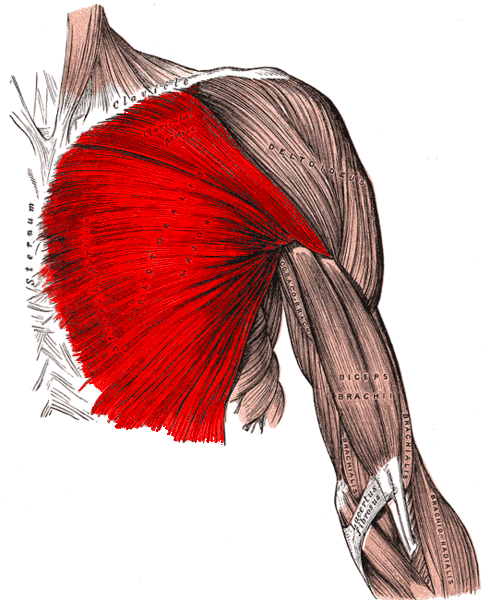
Anatomy of the pectoralis major muscle.
Image and video credits
Gray410 pectoralis major (opens in a new tab) — Arcadian; derivative by Lies Van Rompaey. Public domain (opens in a new tab).
Why Surgery May Be Recommended
Surgery is most often considered when:
- the tendon has torn completely away from the bone
- you want to regain as much strength as possible for work, sports, or weight training
- you have ongoing weakness or a visible change in chest shape
- the tear happened recently and the surgeon believes repair is likely to help
Some partial tears or lower-demand injuries may be treated without surgery. Non-surgical care may help with pain, but some weakness or a change in appearance can remain.
Before Surgery: Common Questions
Patients and families often want to know:
- Will I go home the same day? Many patients do, but this depends on the repair and your overall health.
- What kind of anesthesia is used? General anesthesia is common. Some patients also receive a numbing block to help with pain after surgery.
- Will I need to stop medicines before surgery? Your surgical team will tell you exactly what to do. Ask about blood thinners, diabetes medicines, supplements, nicotine, and anti-inflammatory medicines.
- Will I need help at home? Usually yes, especially for the first few days with dressing, bathing, meals, and sleeping comfortably.
- When can I drive? Usually not while you are wearing a sling, taking opioid pain medicine, or unable to safely control the wheel.
- Will I need physical therapy? In most cases, yes. Therapy is an important part of recovery.
What Happens During the Procedure
At a high level, the surgery usually includes these steps:
- Anesthesia and positioning: You are made comfortable with anesthesia and positioned on your back.
- Incision: The surgeon makes an incision near the front of the shoulder and armpit area to reach the torn tendon.
- Finding the tear: The torn tendon is identified and gently freed so it can be brought back to its normal position.
- Preparing the bone: The attachment area on the humerus, which is the upper arm bone, is prepared for repair.
- Reattaching the tendon: Strong stitches are placed in the tendon and secured to the bone with small implants such as anchors or buttons.
- Extra support if needed: If the tear is older or the tissue does not reach well, a graft may sometimes be used.
- Closing the incision: The incision is closed, covered with a dressing, and the arm is placed in a sling.
The goal is to help the tendon heal back in the right place so the muscle can work better again.
Recovery and Rehabilitation
Most patients have soreness, swelling, and bruising in the chest and upper arm after surgery. Bruising can look dramatic at first and then slowly fade. Pain is usually strongest during the first few days and then gradually improves.
Typical recovery ranges are:
- Sling: about 4 to 6 weeks
- Gentle motion: often starts in the first few weeks, depending on the repair
- Strengthening: often begins around 8 to 12 weeks
- Return to desk work: sometimes 1 to 2 weeks, depending on pain, the sling, and job duties
- Return to heavy lifting, push-ups, contact sports, or weight training: often around 4 to 6 months, sometimes longer
Recovery is not the same for everyone. It depends on the size of the tear, how long ago it happened, tissue quality, and whether a graft was needed.
To protect the repair:
- wear the sling exactly as instructed
- keep the incision clean and dry
- avoid pushing, pulling, lifting, or reaching behind you until cleared
- take pain medicine only as directed
- go to follow-up visits and physical therapy appointments
Risks and Possible Complications
All surgery has risks. Possible problems with pectoralis major tendon repair include:
- infection
- bleeding, swelling, or a collection of blood under the skin
- stiffness or loss of motion
- numbness near the incision or injury to nearby nerves or blood vessels
- the tendon not healing fully or tearing again
- ongoing weakness
- a difference in chest shape or scarring
- blood clots, breathing problems, or anesthesia problems, which are less common but can be serious
Smoking or nicotine use can slow healing and raise the chance of complications.
When to Call the Office
Call your surgical team promptly if you have:
- fever of 101 F (38.3 C) or higher
- worsening redness, warmth, swelling, or drainage at the incision
- pain that is getting worse instead of better
- new numbness, tingling, or unusual swelling in the arm or hand
- a new pop, sudden loss of strength, or a feeling that the repair gave way
- problems with the sling, bandage, or medicines
When to Seek Urgent Care Now
Seek urgent medical care right away or call 911 for:
- chest pain
- shortness of breath
- coughing up blood
- severe bleeding
- severe calf pain or one-sided leg swelling
- a hand that becomes cold, pale, blue, or very hard to move
Questions Patients Often Ask
Will I get all of my strength back?
Many patients regain good strength, but not everyone returns to exactly the same strength as before the injury.
Is bruising normal?
Yes. Bruising across the chest and upper arm is common after the injury and after surgery.
How big will the scar be?
There will be a scar near the front of the shoulder and armpit area. Its size depends on the tear and the repair method.
When can I exercise again?
Walking and some lower-body exercise may be allowed sooner, but chest strengthening and heavy upper-body exercise usually must wait until the tendon has healed and your surgeon clears you.
What if surgery is delayed?
Older tears can be harder to repair because the tendon may shorten or scar. In some cases this changes the type of repair that is possible.
Dr. Rizzo’s physical therapy protocols
These are my own rehabilitation protocols. Your operation, graft, and any additional repairs determine which one applies.
A public pectoralis major repair rehabilitation protocol is not available on this site. Follow the plan in your discharge instructions or contact Dr. Rizzo's team.
Sources
References for further reading about this condition or procedure.
- Pectoralis Tendon Tear (opens in a new tab)
American Academy of Orthopaedic Surgeons (AAOS), OrthoInfo