Snapping Hip Syndrome
Snapping hip is a popping or clicking sensation when a tendon moves over bone around the hip.
Educational content only • Not a substitute for medical advice • For emergencies call 911
What It Is
Snapping hip syndrome is a snapping, popping, or clicking feeling in or around the hip when the leg moves. Even though it can feel dramatic, it usually does not mean the hip is coming out of place.
In many people, the snap happens because a tendon or muscle moves over a bony part of the hip. Sometimes this is painless. Repeated rubbing can irritate nearby tissue, including a small fluid-filled sac called a bursa, and make the hip sore.
Common patterns include:
- Outside of the hip (external snapping): often related to the iliotibial (IT) band or nearby tendons moving over the outer hip bone.
- Front of the hip or groin (internal snapping): often related to the iliopsoas tendon, a major hip flexor.
- Inside the joint: less common, but a torn labrum (the ring of cartilage around the hip socket) or a loose piece of tissue can cause catching or snapping.
Anatomy and imaging
These illustrations and imaging examples can help you understand the anatomy. They do not show your diagnosis.
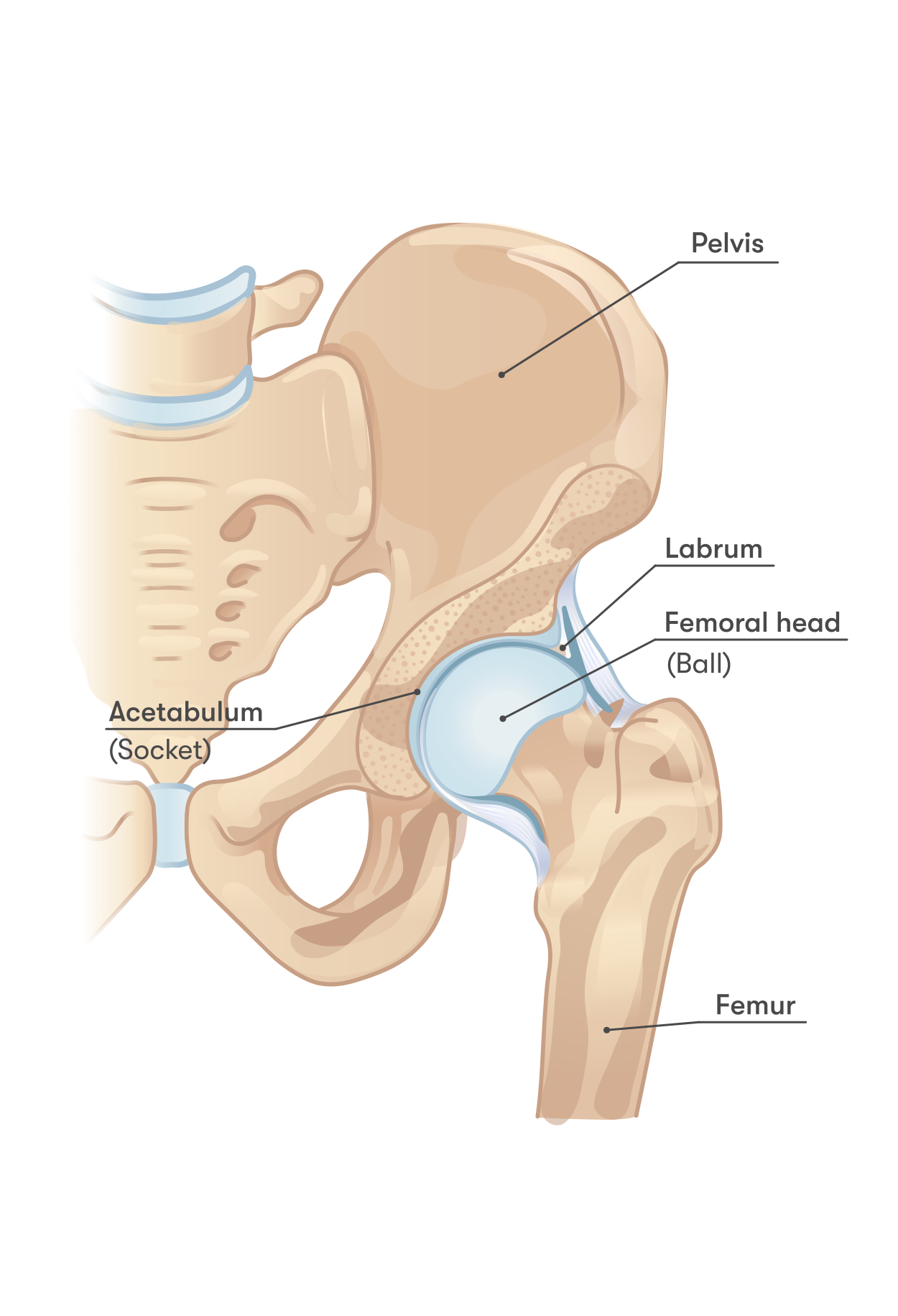
Hip anatomy for orientation.
Image and video credits
Hip anatomy (opens in a new tab) — InjuryMap. CC BY-SA 4.0 (opens in a new tab).
Symptoms
People may notice:
- a snap, pop, or click when walking, standing up, climbing stairs, running, dancing, kicking, or swinging the leg
- a feeling of snapping at the front, side, or less often back of the hip
- tightness, soreness, or aching after activity
- tenderness over the outside or front of the hip
- a catching feeling with certain movements
Some people hear or feel the snap without pain. Pain, repeated catching, or trouble with daily activities matters more than the sound alone.
Causes and Risk Factors
Snapping hip is more likely when there is:
- tightness in the hip flexors, IT band, hamstrings, or other tendons
- repetitive hip motion from sports, dance, running, or cycling
- weakness in the hip or core muscles
- a sudden increase in training
- a prior hip injury
- a growth spurt in adolescents
How Diagnosis Is Made
A clinician usually diagnoses snapping hip from your symptoms and a physical exam. They may ask you to move your hip in ways that reproduce the snap and check exactly where it happens.
Imaging is not always needed, but it may help when pain is significant, symptoms are lasting, or there is concern for another hip problem.
- X-rays can look for bone shape and other joint problems.
- Ultrasound can sometimes show a tendon moving in real time while the hip snaps.
- MRI may be used if there is concern for a labral tear or another problem inside the joint.
Nonsurgical Treatment
Most people improve without surgery. Treatment usually starts with lowering irritation and improving strength and flexibility.
Common nonsurgical care includes:
- Activity changes: temporarily reduce the movements that trigger snapping and pain, then return gradually.
- Ice: use after activity if the hip is sore or swollen.
- Pain relief: over-the-counter medicines may help if your clinician says they are safe for you.
- Physical therapy: this often includes stretching, hip and core strengthening, posture and movement training, and a gradual return to sports or exercise.
- Training changes: warm up longer, avoid sudden jumps in intensity, and add rest or cross-training when needed.
If pain keeps going, a clinician may sometimes discuss an injection to calm an irritated area or help confirm where the pain is coming from.
When Surgery May Be Discussed
Surgery is uncommon. It may be discussed when:
- pain has lasted for months despite a good trial of nonsurgical care
- snapping keeps limiting walking, work, sports, dance, or sleep
- the exam and imaging show a specific problem that can be treated
The type of surgery depends on the cause. Options may include lengthening or releasing a tight tendon, or hip arthroscopy to treat a labral tear or another problem inside the joint.
Recovery and Outlook
Many people improve over several weeks to a few months with stretching, strengthening, and activity changes. Recovery can take longer if symptoms have been present for a long time or if there is another hip problem along with the snapping.
Helpful expectations:
- painless snapping may not need much treatment
- painful snapping often improves gradually, not overnight
- returning too quickly to running, deep squats, high kicks, or other trigger movements can bring symptoms back
- if surgery is needed, recovery is longer and usually includes physical therapy for several months
When to Seek Urgent Help or Call the Office
Seek urgent care now if:
- you cannot put weight on the leg after a fall or sudden injury
- the hip feels stuck, locked, or looks out of place
- you have severe or rapidly worsening pain
- you have fever with marked redness, warmth, or fast-growing swelling around the hip
- you have new numbness or weakness in the leg
Call the office if:
- the snapping becomes painful or is getting worse
- symptoms are limiting walking, stairs, school, work, sports, or sleep
- pain is not improving after a few weeks of home care
- you keep having repeated flare-ups
- you have deep groin pain or a catching feeling that seems to come from inside the joint
Lowering the Chance It Returns
- keep up the home stretching and strengthening program you were given
- increase exercise intensity gradually
- warm up before sports or workouts
- take rest days when training volume is high
- use supportive footwear and replace worn-out shoes when needed
Sources
References for further reading about this condition or procedure.
- Snapping Hip (opens in a new tab)
American Academy of Orthopaedic Surgeons (AAOS), OrthoInfo
- Hip Arthroscopy (opens in a new tab)
American Academy of Orthopaedic Surgeons (AAOS), OrthoInfo