Distal Femoral Osteotomy
A distal femoral osteotomy changes the alignment of the thighbone near the knee.
Educational content only • Not a substitute for medical advice • For emergencies call 911
What Is a DFO?
Distal femoral osteotomy, or DFO, is a surgery that changes the angle of the thigh bone just above the knee. The goal is to shift pressure away from the damaged part of the knee and toward the healthier part.
This surgery is most often used for people with valgus alignment, also called "knock-knee," and pain or arthritis mainly on the outer (lateral) side of the knee. It is usually considered for younger or more active patients who want to preserve their own knee joint as long as possible.
A DFO can reduce pain and improve function. It may delay knee replacement, but it does not cure arthritis or make the knee normal again.
Anatomy and imaging
These illustrations and imaging examples can help you understand the anatomy. They do not show your diagnosis.
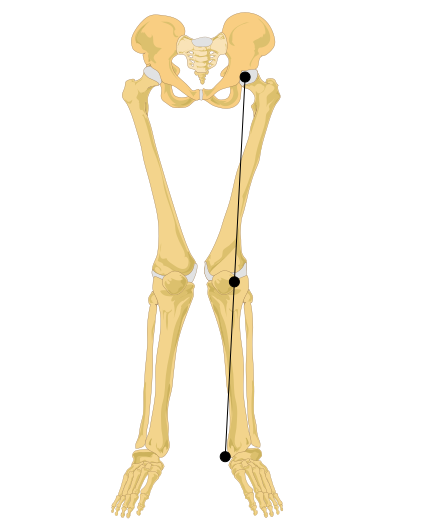
Simplified example of valgus alignment.
Image and video credits
Genu valgum (opens in a new tab) — LadyofHats, Jecowa, and Stündle. CC0 1.0 (opens in a new tab).
Why It May Be Recommended
- Pain on one side of the knee, especially the outer side
- Knock-kneed alignment that puts too much pressure on that side of the knee
- Arthritis or cartilage damage that is mostly limited to one part of the knee
- Symptoms that continue despite nonsurgical care, such as physical therapy, activity changes, braces, medicines, or injections
- A goal of delaying knee replacement
How the Surgery Works
Before surgery, your surgeon uses X-rays and sometimes other imaging to measure the alignment and plan the correction.
During the operation:
- You receive anesthesia so you do not feel pain.
- The surgeon makes an incision near the lower end of the femur, the thigh bone above the knee.
- A controlled cut is made in the bone.
- The bone is realigned.
- In a closing wedge DFO, a small wedge of bone is removed and the bone is closed to change the angle.
- In an opening wedge DFO, the bone is gently opened to the planned angle, and the gap may be supported with bone graft or a bone substitute.
- Plates and screws hold the bone in the new position while it heals.
- The incision is closed and covered with a dressing.
A DFO is sometimes combined with another knee procedure, such as meniscus, cartilage, or ligament surgery. If that happens, recovery may be longer.
Questions Patients Often Ask Before Surgery
- Will I need to stop blood thinners, anti-inflammatory medicines, supplements, nicotine, or smoking before surgery?
- Will I need crutches, a brace, or a walker at home?
- Will I stay overnight in the hospital?
- Will I need a bone graft or another knee procedure at the same time?
- What is the plan for pain control after surgery?
- What will you do to lower the risk of blood clots?
- How much help will I need at home during the first 1 to 2 weeks?
- When can I shower, drive, return to work or school, and get back to exercise?
- If the plate or screws bother me later, could they need to be removed?
Do not stop prescription medicines unless your surgical team tells you to. They should give you specific instructions about eating, drinking, medicines, arrival time, and equipment to bring on the day of surgery.
What to Expect Right After Surgery
- Pain, swelling, bruising, and stiffness are common at first.
- You may go home the same day or stay overnight, depending on pain control, walking safety, and whether other procedures were done.
- You will usually start gentle knee motion early, often with help from physical therapy.
- Many patients use crutches for about 6 weeks or longer.
- Weight bearing is often limited at first and then increased as X-rays show healing.
- Some patients wear a brace for part of recovery.
- Ice, elevation, compression, and prescribed medicines can help with pain and swelling.
- You may be given medicine or other instructions to help prevent blood clots.
Recovery and Return to Activity
Recovery is gradual. The bone has to heal before the leg can safely do more.
- First 2 weeks: focus on rest, swelling control, incision care, safe walking with crutches, and gentle motion.
- About 6 weeks: many patients are still using crutches or are slowly adding weight to the leg, depending on healing.
- 2 to 3 months: walking and daily activities usually get easier, and therapy often shifts toward strength and balance.
- 3 to 6 months: many people begin lower-impact exercise, such as cycling, swimming, or elliptical training, if healing is on track.
- 6 to 12 months and beyond: stronger exercise and some sports may be possible after clearance. Running, jumping, and pivoting sports often take 8 to 12 months or longer.
Many people can return to desk-type work after several weeks, but jobs that require prolonged standing, climbing, kneeling, or lifting often take a few months or more. Driving is usually delayed until you can safely control the leg and are no longer taking opioid pain medicine. Ask your surgeon for specific guidance.
Complete recovery often takes several months, and some people continue to improve for up to a year. Not everyone returns to the same level of sport or activity as before surgery.
Risks and Possible Complications
All surgery has risks. With DFO, important risks include:
- Infection
- Bleeding
- Blood clots in the leg or lungs
- Slow bone healing or bone that does not fully heal
- Stiffness, ongoing pain, or swelling
- Irritation from the plate or screws
- The leg being corrected too much or not enough
- Injury to nearby nerves or blood vessels
- Need for another surgery, including hardware removal or future knee replacement
Following instructions about wound care, weight bearing, physical therapy, and avoiding smoking or nicotine can help lower some risks.
When to Call the Office
- Fever or chills
- Increasing redness, warmth, swelling, or drainage at the incision
- Pain that is getting worse instead of slowly improving
- Trouble taking your medicines because of nausea, vomiting, rash, or constipation
- New numbness or tingling that does not go away
- Questions about wound care, the brace, or how much weight to put on the leg
When to Seek Urgent Care
Call 911 or go to the emergency room if you have:
- Chest pain or trouble breathing
- Sudden calf pain or major swelling in the calf or thigh
- A foot that becomes cold, pale, blue, or hard to move
- Heavy bleeding or drainage that quickly soaks through the dressing
- A fall or sudden injury after surgery with severe pain or an inability to bear weight
Dr. Rizzo’s physical therapy protocols
These are my own rehabilitation protocols. Your operation, graft, and any additional repairs determine which one applies.
Distal Femoral Osteotomy Protocol
Use when your discharge instructions name distal femoral osteotomy (DFO).
Open protocol PDF (opens in a new tab)Sources
References for further reading about this condition or procedure.
- Osteotomy of the Knee (opens in a new tab)
American Academy of Orthopaedic Surgeons (AAOS), OrthoInfo