Proximal Humerus Fracture
A proximal humerus fracture is a break near the top of the upper arm bone, close to the shoulder joint.
Educational content only • Not a substitute for medical advice • For emergencies call 911
What It Is
A proximal humerus fracture is a break in the upper arm bone near the shoulder joint. "Proximal" means the part of the bone closest to the shoulder.
These fractures often happen after a fall, especially in older adults with osteoporosis (thinner, weaker bone). They can also happen after sports injuries, car crashes, or other higher-force trauma.
Many proximal humerus fractures heal without surgery. The main goals of treatment are to let the bone heal, control pain, and help the shoulder recover as much movement and strength as possible.
Anatomy and imaging
These illustrations and imaging examples can help you understand the anatomy. They do not show your diagnosis.
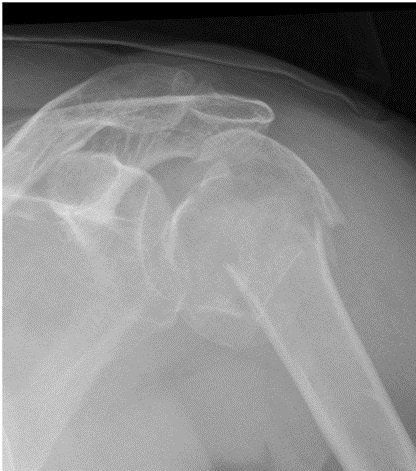
Example of a complex proximal humerus fracture.
Image and video credits
X-ray of complex fracture of proximal humerus (opens in a new tab) — Georg Mattiassich, Lucian Lior Marcovici, Rolf Michael Krifter, Reinhold Ortmaier, Peter Wegerer, and Albert Kroepfl. CC BY 2.0 (opens in a new tab).
Common Causes and Risk Factors
- A fall onto the hand, elbow, or shoulder
- Osteoporosis or other bone weakness
- Car crashes or sports injuries
- Long-term steroid use or other medical conditions that weaken bone
- Less commonly, a bone weakened by a tumor or cyst
Common Symptoms
- Sudden pain in the shoulder or upper arm
- Swelling and tenderness
- Bruising around the shoulder or down the arm over the next few days
- Trouble lifting, turning, or using the arm
- Pain even with small movements
- A change in shoulder shape in some injuries
- Numbness, tingling, or weakness if nearby nerves are irritated
Bruising often spreads down the upper arm after a few days. This can look dramatic, but it is common after this type of injury.
How It Is Diagnosed
Your clinician will ask how the injury happened and examine your shoulder, arm, hand, skin, nerve function, and blood flow.
Tests may include:
- X-rays: the main test to show the fracture and whether the pieces are still lined up
- CT scan: sometimes used if the fracture is more complex or extends into the joint
- MRI: not usually needed, but sometimes used if there is concern about tendon injury or blood supply to the bone
If the fracture happened after a simple fall, especially in an older adult, the care team may also discuss bone health and osteoporosis testing.
Treatment Without Surgery
Many people do well without surgery, especially when the broken pieces have not moved much.
Nonsurgical treatment often includes:
- A sling or shoulder immobilizer: to support and protect the arm
- Pain control: ice, over-the-counter medicine, or prescribed medicine as directed
- Movement of the hand, wrist, and elbow: when your clinician says it is safe, to limit stiffness
- Gentle shoulder exercises at the right time: to help prevent a very stiff shoulder
- Follow-up visits and X-rays: to make sure the fracture stays in a good position as it heals
Helpful day-to-day tips:
- Sleeping partly upright or with pillows under the arm is often more comfortable.
- Avoid lifting, pushing, pulling, or reaching overhead until your care team says it is safe.
- Driving is usually not safe while you are in a sling or while taking pain medicine that makes you drowsy.
When Surgery May Be Discussed
Surgery may be discussed when:
- The broken pieces have shifted far out of place
- The fracture extends into the shoulder joint
- The shoulder is unstable or dislocated
- The skin is broken over the fracture
- There is concern about damage to nerves, blood vessels, or blood supply to the ball of the shoulder
- The fracture is unlikely to heal well with a sling alone
Possible operations include:
- Fixing the bone with plates, screws, pins, or a rod: often called open reduction and internal fixation (ORIF)
- Replacing part or all of the shoulder joint: used in some severe fractures, especially when the bone is badly broken or bone quality is poor
Surgery is not automatically better for every patient. For many people, careful sling treatment and therapy give good pain relief and useful shoulder function.
Recovery and What to Expect
Healing time depends on the exact fracture, your bone quality, and whether surgery was needed.
In general:
- Pain and swelling are often worst in the first 1 to 2 weeks.
- Early bone healing is commonly seen on X-rays within about 6 to 12 weeks.
- Shoulder motion and strength often improve over several months.
- After a more complex fracture or surgery, improvement may continue for 6 to 12 months.
It is common to have:
- Stiffness
- Weakness
- Trouble reaching overhead for a while
- Soreness as activity slowly increases
A realistic goal is less pain and useful daily shoulder function. Some people do not regain full shoulder motion or strength, especially after more complex fractures.
Possible problems include slow healing, the bone healing in a poor position, ongoing stiffness, nerve irritation, or loss of blood supply to part of the bone. That last problem is called avascular necrosis.
When to Call the Office
Call your clinician if:
- Pain or swelling is getting worse instead of slowly improving
- Your sling does not fit well or you cannot manage basic daily care
- You have new or increasing numbness or tingling
- You have fever, redness, drainage, or a bad smell from an incision or wound
- You cannot do the exercises you were told to do because of pain
- You have questions about bathing, dressing, work, school, or driving
When to Seek Urgent Care
Seek urgent care right away if:
- Your hand or arm becomes cold, pale, blue, or very swollen
- You suddenly cannot move your fingers
- You have severe numbness or rapidly worsening weakness
- There is an open wound, bleeding you cannot control, or bone showing through the skin
- Pain becomes severe and is not relieved by the plan from your care team
- You were injured in a major fall or crash and also have trouble breathing, chest pain, a severe headache, or other serious injuries
Prevention and Bone Health
To lower the chance of future fractures:
- Reduce fall risks at home, such as loose rugs, poor lighting, and clutter
- Ask about osteoporosis screening if this fracture happened after a simple fall
- Get enough calcium and vitamin D if recommended by your clinician
- Stay active with safe balance and strength exercises
- Avoid smoking and nicotine, which can slow bone healing
Sources
References for further reading about this condition or procedure.
- Shoulder Trauma (Fractures and Dislocations) (opens in a new tab)
American Academy of Orthopaedic Surgeons (AAOS), OrthoInfo