Anatomic Shoulder Replacement
An anatomic shoulder replacement replaces the damaged ball and socket surfaces with implants.
Educational content only • Not a substitute for medical advice • For emergencies call 911
What this surgery is
Anatomic total shoulder replacement is surgery to replace a badly damaged shoulder joint with artificial parts. The new parts keep the shoulder in the same general shape as a natural shoulder: a metal ball replaces the top of the arm bone, and a smooth plastic socket replaces the worn socket on the shoulder blade.
This operation is called "anatomic" because it keeps the usual ball-and-socket layout. It is different from a reverse shoulder replacement. The main goals are to reduce pain and improve movement for daily activities. It does not guarantee a completely normal shoulder.
Anatomy and imaging
These illustrations and imaging examples can help you understand the anatomy. They do not show your diagnosis.
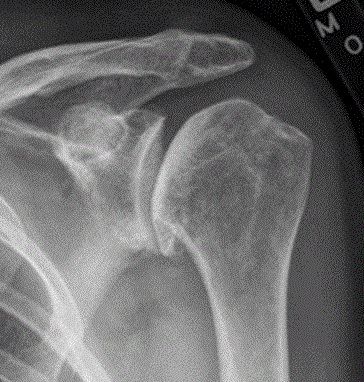
Example shoulder X-ray showing osteoarthritis.
Image and video credits
X-ray of osteoarthritis of the shoulder (opens in a new tab) — Vladimir V. Senatorov, Ramon Cuevas-Trisan, Francisco J. Garcia, Gabriel P. Suciu, Robert H. Parkes, and Alina M. Alonso. CC BY 4.0 (opens in a new tab).
Why it may be recommended
Your surgeon may recommend this surgery when shoulder pain and stiffness are severe and other treatments have not helped enough, such as:
- activity changes
- medicines
- physical therapy
- steroid injections
It is most often used for:
- severe osteoarthritis, which is wear-and-tear arthritis
- some inflammatory arthritis
- certain complex fractures
- joint damage when the rotator cuff is still working well
The rotator cuff is the group of tendons that helps lift and rotate the arm. If those tendons are badly torn, a different operation, called reverse shoulder replacement, may be a better fit.
People considering this surgery often have:
- pain with daily use
- pain at night
- loss of motion
- trouble reaching overhead, behind the back, or away from the body
What happens during surgery
At a high level, the surgery usually involves these steps:
- You receive anesthesia so you do not feel the operation. Many patients also get a nerve block to help with pain after surgery.
- The surgeon makes an incision at the front of the shoulder.
- The damaged cartilage, which is the smooth lining on the ends of the bones, and damaged bone are removed.
- The top of the arm bone is replaced with a metal ball. The socket is fitted with a smooth plastic liner.
- The surgeon checks the shoulder for fit, stability, and movement, then closes the incision.
Surgery often takes about 1 to 3 hours, but times vary.
Before surgery: practical questions to ask
It is reasonable to ask your surgeon and care team:
- Why is anatomic shoulder replacement the right choice for me?
- Is my rotator cuff healthy enough for this type of replacement?
- Will I go home the same day or stay overnight?
- Which medicines should I stop or continue before surgery, especially blood thinners, diabetes medicines, and supplements?
- When do I need to stop eating and drinking before surgery?
- How long will I need the sling?
- When will physical therapy start?
- When can I shower, drive, return to work, and sleep on that side again?
- What help will I need at home for dressing, bathing, meals, and rides?
- Are there long-term limits on heavy lifting or sports after recovery?
Right after surgery
Many people go home the same day or stay 1 night in the hospital.
After surgery, it is common to have:
- a sling for comfort and protection
- shoulder soreness and swelling
- numbness or weakness for a limited time if a nerve block was used
- tiredness for several days
You will usually be asked to move your fingers, wrist, and elbow soon after surgery. Shoulder exercises often begin early, but only in the ways your surgeon or therapist allows.
Recovery and rehabilitation
Recovery is gradual. Exact timing depends on your bone quality, soft tissue healing, overall health, and your surgeon's plan.
Typical recovery ranges are:
- Sling use: often several weeks
- Gentle motion exercises: often start soon after surgery
- Strengthening: usually added later, after early healing
- Driving: usually not until you can safely control the arm and are off opioid pain medicine; this is often several weeks
- Desk work or light duties: often within 2 to 6 weeks, depending on pain and sling use
- Heavier work, lifting, or sports: often several months, and some activities may stay limited
- Full improvement: pain relief and function often continue to improve for 6 to 12 months
Most people notice less pain first. Strength and endurance usually take longer to return. Even after a successful surgery, the shoulder may not feel exactly like a normal, younger joint. Many surgeons recommend avoiding very heavy repetitive lifting, especially overhead, to help protect the implant over time.
Possible risks and complications
All surgery has risks. Commonly discussed risks of shoulder replacement include:
- infection
- bleeding, bruising, or a blood clot
- stiffness or less motion than hoped
- ongoing pain
- the joint feeling unstable or coming out of place
- injury to nearby nerves or blood vessels
- fracture of the arm bone or shoulder bone
- problems with the rotator cuff or other soft tissues
- the implant wearing out, loosening, or needing another surgery in the future
- anesthesia or other medical complications
Your surgical team works to lower these risks, but no procedure can remove them completely.
When to call the office
Call your surgeon's office promptly if you have:
- fever over 101 F (38.3 C)
- increasing redness, warmth, drainage, or a bad smell from the incision
- pain or swelling that is getting worse instead of better
- new numbness, tingling, or weakness in the hand or arm
- trouble moving your fingers
- side effects from medicines, such as severe nausea, rash, or constipation that is not improving
- questions about the sling, dressing, or exercises
When to seek urgent care
Seek urgent or emergency care right away for:
- chest pain
- shortness of breath
- new calf pain or marked calf swelling
- the hand becoming cold, blue, or very pale
- sudden severe shoulder pain after a fall or a popping sensation, especially if the shoulder looks out of place
- heavy bleeding or drainage soaking through the bandage
Dr. Rizzo’s physical therapy protocols
These are my own rehabilitation protocols. Your operation, graft, and any additional repairs determine which one applies.
Anatomic Total Shoulder Arthroplasty Protocol
Use when your discharge instructions name an anatomic total shoulder replacement.
Open protocol PDF (opens in a new tab)Sources
References for further reading about this condition or procedure.
- Shoulder Joint Replacement (opens in a new tab)
American Academy of Orthopaedic Surgeons (AAOS), OrthoInfo