Reverse Shoulder Replacement
A reverse shoulder replacement changes the position of the ball and socket so the deltoid muscle can help lift the arm.
Educational content only • Not a substitute for medical advice • For emergencies call 911
What This Surgery Is
A reverse total shoulder replacement is a type of shoulder replacement in which the usual ball-and-socket parts are switched. A metal ball is attached to the shoulder blade, and a socket-shaped cup is attached to the upper arm bone.
This design helps the deltoid muscle do more of the work of lifting the arm when the rotator cuff is badly torn or no longer working well. The main goals are to reduce pain and improve daily function.
Reverse shoulder replacement can help many people, but it does not make the shoulder completely normal again. Some limits in strength, motion, or heavy use may remain.
Anatomy and imaging
These illustrations and imaging examples can help you understand the anatomy. They do not show your diagnosis.
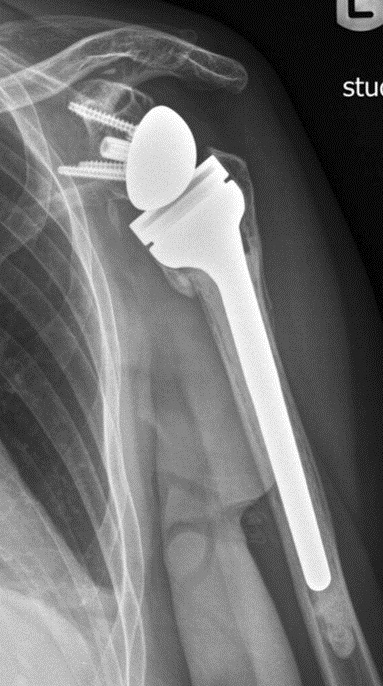
Illustrative X-ray; implant designs and surgical plans vary.
Image and video credits
Reverse shoulder arthroplasty at one year (opens in a new tab) — Georg Mattiassich, Lucian Lior Marcovici, Rolf Michael Krifter, Reinhold Ortmaier, Peter Wegerer, and Albert Kroepfl. CC BY 2.0 (opens in a new tab).
Why It May Be Recommended
This surgery may be recommended when shoulder pain and loss of function are severe and other treatments have not helped enough. Common reasons include:
- Shoulder arthritis with a large rotator cuff tear
- A severe fracture near the top of the upper arm bone
- A failed previous shoulder replacement
- Long-standing shoulder damage, deformity, or instability in selected cases
Common Questions Before Surgery
- Do I need to try other treatments first? Often, yes. Many people try medicines, injections, activity changes, or physical therapy before surgery, unless the shoulder problem is severe enough that surgery is the better first option.
- Will I go home the same day? Many patients do, while others stay one night. This depends on your overall health, pain control, and support at home.
- Will I need help at home? Usually yes for the first several days. Help with meals, dressing, bathing, and rides is often useful.
- How should I prepare? Ask which medicines or supplements to stop before surgery, especially blood thinners. Follow instructions about eating and drinking before surgery. Set up your home so often-used items are easy to reach without overhead lifting.
- How long will I wear a sling? Often about 2 to 6 weeks, depending on your surgeon’s plan.
- When can I drive? Not until you can safely control the arm, are no longer taking opioid pain medicine or other medicines that make you drowsy, and your surgeon says it is safe.
- Will I need physical therapy? Usually yes. Therapy is an important part of safely getting motion and function back.
- Will I get full motion back? Not always. The usual goal is less pain and better use of the arm for daily activities, not a perfectly normal shoulder.
What Happens During Surgery
At a high level, the procedure usually involves these steps:
- You receive anesthesia so you are asleep or comfortable during surgery.
- The surgeon makes an incision over the shoulder.
- Damaged bone and worn joint surfaces are removed.
- The new parts are placed so the ball is on the shoulder blade side and the socket is on the arm side.
- The surgeon checks the fit, stability, and movement of the new joint.
- The incision is closed and covered with a dressing.
Surgery often takes about 1 to 2 hours, but it can take longer in more complex cases.
Recovery and Rehabilitation
Recovery happens in stages, and your exact plan depends on your bone quality, muscles and tendons, and whether this is your first shoulder replacement or a revision surgery.
- Right after surgery: Your arm is placed in a sling. Pain, swelling, bruising, and tiredness are common. If you had a nerve block, the arm may feel numb or weak for a while.
- First few weeks: The sling helps protect the shoulder. Gentle hand, wrist, and elbow movement usually starts early. Sleeping slightly reclined or with pillows for support is often more comfortable.
- Physical therapy: Therapy usually begins with gentle, protected motion. Strengthening is added later, especially to help the deltoid muscle work well.
- Daily activities: Light activities at waist level may return over the first several weeks if your surgeon says it is safe. Desk work may return sooner than jobs that involve lifting, pushing, pulling, or overhead use.
- Longer-term recovery: Many people notice pain relief within a few weeks, but reaching and strength improve more gradually. Recovery often continues over 3 to 6 months, with improvement sometimes continuing up to a year.
Activities that may stay limited include:
- Very heavy lifting
- Forceful pushing or pulling
- Repeated overhead strain
- Sudden jerking movements
- High-impact use or falls onto the arm
Risks and Possible Complications
All surgery has risks. Important risks of reverse shoulder replacement include:
- Infection
- Bleeding or a collection of blood under the skin
- Blood clots
- Injury to nerves or blood vessels
- Fracture of the arm bone or shoulder blade
- Stiffness or ongoing pain
- The joint slipping out of place
- Loosening or wear of the implant over time
- Problems related to anesthesia or other medical conditions
These problems are not expected for most patients, but it is important to understand them before surgery.
When to Call the Office
Call your surgical team promptly if you have:
- Fever over 101°F (38.3°C)
- Increasing redness, warmth, drainage, or bad odor at the incision
- Swelling that is getting worse instead of better
- Pain that is not controlled with the plan you were given
- New numbness, tingling, weakness, or trouble moving the fingers
- A new pop, the shoulder looking out of place, or sudden loss of motion
- New calf pain or calf swelling
When to Seek Urgent Care
Seek urgent care right away if you have:
- Chest pain
- Trouble breathing
- Severe bleeding
- A hand that becomes cold, blue, or very pale
- Severe pain or sudden swelling after a fall or new injury
Dr. Rizzo’s physical therapy protocols
These are my own rehabilitation protocols. Your operation, graft, and any additional repairs determine which one applies.
Reverse Total Shoulder Arthroplasty With Subscapularis Repair Protocol
Use only when your discharge instructions name reverse total shoulder replacement with subscapularis repair.
Open protocol PDF (opens in a new tab)Sources
References for further reading about this condition or procedure.
- Reverse Total Shoulder Replacement (opens in a new tab)
American Academy of Orthopaedic Surgeons (AAOS), OrthoInfo
- Shoulder Joint Replacement (opens in a new tab)
American Academy of Orthopaedic Surgeons (AAOS), OrthoInfo