Proximal Hamstring Tear
A proximal hamstring tear injures the tendons near the sit bone at the back of the pelvis.
Educational content only • Not a substitute for medical advice • For emergencies call 911
What Is a Proximal Hamstring Tear?
The hamstrings are a group of muscles on the back of the thigh. They help bend the knee and move the hip backward. At the top of the thigh, the hamstring tendons attach to the pelvis near the "sit bone" (ischial tuberosity).
A proximal hamstring tear happens when one of these tendons is overstretched or tears near that attachment point. The tear may be:
- Partial: some of the tendon fibers are torn
- Complete: the tendon pulls fully off the bone, sometimes called an avulsion
This injury is different from a more common hamstring strain lower down in the thigh.
Anatomy and imaging
These illustrations and imaging examples can help you understand the anatomy. They do not show your diagnosis.
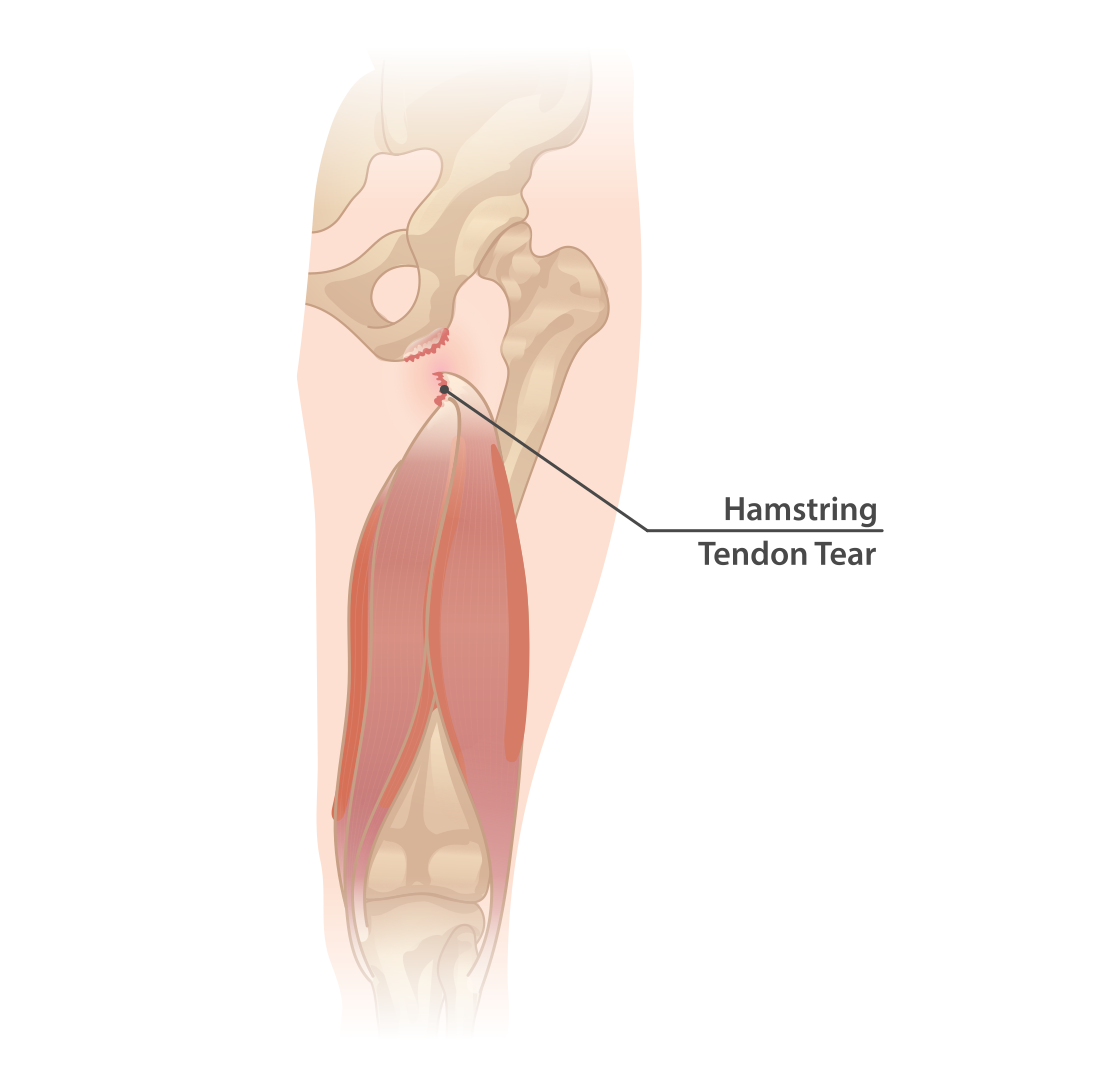
This illustration shows the hamstring region; proximal repair concerns tears near the sitting bone.
Image and video credits
Hamstring tear (opens in a new tab) — InjuryMap. CC BY-SA 4.0 (opens in a new tab).
Common Causes
A proximal hamstring tear usually happens during a sudden, forceful movement, such as:
- Sprinting or jumping
- Slipping into a split
- A fall
- A water-skiing injury
- A sudden kick or lunge
Risk may be higher with:
- A past hamstring injury
- Muscle fatigue or tightness
- A sudden increase in training
- Reduced strength or conditioning
- Older age
Common Symptoms
People often notice:
- Sudden sharp pain in the buttock or upper back of the thigh
- A popping or snapping feeling at the time of injury
- Bruising or swelling in the back of the thigh, sometimes spreading downward over a few days
- Pain with walking, climbing stairs, bending, or sitting
- Weakness when pushing off, running, or standing up from a seated position
- Trouble continuing the activity after the injury
With a larger tear, there may be:
- Major difficulty walking
- A visible change in the shape of the upper thigh
- A feeling that the leg is weak or unreliable
How Diagnosis Is Made
A clinician usually starts with your story and a physical exam. They may check for:
- Tenderness near the sit bone
- Bruising or swelling
- Pain with stretching or strength testing
- Changes in walking
- Loss of strength
Imaging is sometimes used to confirm the injury and see how severe it is:
- X-rays can show whether a small piece of bone was pulled away with the tendon
- MRI is often the most helpful test when a complete tear is suspected or surgery is being considered
- Ultrasound can sometimes show the tear, but it may not give as much detail as MRI
Not every mild injury needs imaging right away.
Nonsurgical Treatment
Many partial tears, and some complete tears, can be treated without surgery.
Early care often includes:
- Rest from running, jumping, heavy lifting, and other painful activities
- Ice for 15 to 20 minutes at a time during the first few days
- Compression shorts or a wrap if recommended
- Crutches for a short time if walking is painful
- Pain medicine such as acetaminophen or an anti-inflammatory medicine if your clinician says it is safe for you
Physical therapy is a key part of recovery. Rehab usually focuses on:
- Gentle motion at first
- Gradual strengthening
- Balance and movement training
- A slow return to sports or exercise
Deep stretching early after the injury can make symptoms worse. Recovery is usually better with a gradual plan.
Injections are not routine first-line treatment. In some cases, a clinician may discuss them, but they are not needed for most patients.
When Surgery May Be Discussed
Surgery may be discussed if:
- Two or three hamstring tendons are completely torn from the bone
- The tendon has pulled back a significant distance
- There is ongoing pain, weakness, or loss of function after a good trial of rehabilitation
- Work or sports require high strength and speed
Surgery usually reattaches the torn tendon to the bone. For larger tears, earlier evaluation can matter because long-standing tears can be harder to repair.
Recovery Expectations
Recovery depends on how severe the tear is.
In general:
- Pain and bruising often begin to improve over the first few weeks
- Partial tears may take several weeks to a few months to recover
- Return to daily activities usually comes before return to running or sports
- Strength often returns more slowly than pain improves
If surgery is needed:
- Crutches and activity limits are common at first
- Physical therapy is usually needed for several months
- Return to sports often takes about 4 to 6 months, and sometimes longer
Most people improve with the right treatment plan, but recovery can take time.
When to Seek Urgent Help
Get urgent medical care if you have:
- Severe pain after a pop and cannot bear weight
- Rapidly increasing swelling or bruising
- New numbness or new weakness in the leg or foot
- A leg that looks pale or feels cold
- Loss of bladder or bowel control
- Chest pain or shortness of breath, especially after surgery
When to Call the Office
Call your clinician if:
- Pain, limping, or sitting pain is not improving
- You are having trouble with normal daily activities because of pain or weakness
- You think you may have a complete tear
- You develop fever, redness, drainage, or worsening pain after surgery
- You develop calf pain or calf swelling after surgery or after a period of reduced activity
Lowering the Risk of Reinjury
Helpful steps include:
- Warming up before sports or exercise
- Increasing activity gradually
- Working on hamstring, hip, and core strength
- Addressing old hamstring problems before returning to full-speed activity
- Following a guided return-to-sport plan after injury
Sources
References for further reading about this condition or procedure.
- Hamstring Muscle Injuries (opens in a new tab)
American Academy of Orthopaedic Surgeons (AAOS), OrthoInfo