Greater Trochanteric Pain & Bursitis
Pain on the outside of the hip may involve an irritated bursa, nearby tendons, or both.
Educational content only • Not a substitute for medical advice • For emergencies call 911
What It Is
Hip bursitis is irritation of a bursa, a small fluid-filled sac that helps tissues glide smoothly over bone. In the hip, bursitis most often affects the bursa over the bony point on the outside of the hip. This is often called trochanteric bursitis.
Less often, bursitis can affect a bursa in the front of the hip near the groin.
Many people use the term "hip bursitis" for outer hip pain. Sometimes the nearby tendons are irritated too, not just the bursa. Some clinicians call this greater trochanteric pain syndrome, which means pain coming from the outer hip area.
Anatomy and imaging
These illustrations and imaging examples can help you understand the anatomy. They do not show your diagnosis.
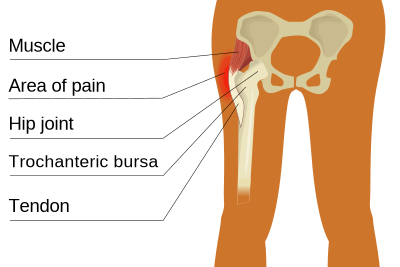
The usual pain region in greater trochanteric pain syndrome.
Image and video credits
Greater trochanteric pain syndrome (opens in a new tab) — Hariadhi. CC BY-SA 4.0 (opens in a new tab).
Common Symptoms
People with hip bursitis may notice:
- Pain on the outside of the hip or upper thigh
- Tenderness when pressing on the side of the hip
- Pain that is worse when lying on that side
- Pain with walking, climbing stairs, standing up from a chair, or walking uphill
- Aching that may spread down the outer thigh
- A limp or stiffness because the hip hurts to move
- Less commonly, pain in the front of the hip or groin, especially when lifting the knee or getting out of a car
Visible swelling is often mild or absent because the hip bursae are deeper than bursae near the elbow or knee.
Why It Happens
Hip bursitis can happen when the tissues around the hip get irritated over time or after an injury. Common causes and risk factors include:
- Repetitive activity, such as running, stair climbing, or standing for long periods
- A fall or direct blow to the hip
- Lying for long periods on one side
- Weak hip muscles or tight tissues around the hip
- Differences in walking pattern, leg length, or foot mechanics
- Bone spurs or calcium deposits near the tendons
- Back problems or arthritis that change how the hip moves
- Prior hip surgery
How Diagnosis Is Made
Diagnosis is usually based on your symptoms and a physical exam.
Your clinician may:
- Ask where the pain is and what activities make it worse
- Press on the hip to find tender areas
- Check how you walk
- Test hip movement, strength, and flexibility
- Look for signs of other problems, such as arthritis, tendon injury, or pain coming from the back
Tests are not always needed, but they may be used to rule out other causes of hip pain:
- X-rays can help look for arthritis, bone spurs, or a fracture
- Ultrasound or MRI may be used if the diagnosis is unclear or symptoms are not improving
- Blood tests or fluid testing may be needed if infection is a concern, though this is uncommon
Treatment Without Surgery
Most people get better without surgery. Treatment usually starts with simple steps.
Activity Changes and Home Care
- Avoid or cut back on activities that clearly worsen the pain for a while
- Keep moving gently; strict bed rest is usually not helpful
- Use ice for 15 to 20 minutes at a time, several times a day, especially after activity
- Do not put ice directly on the skin
- Avoid lying on the painful side
- Try sleeping on the other side with a pillow between the knees, or on your back
Medicines
- Anti-inflammatory pain medicines such as ibuprofen or naproxen may help with pain and swelling if they are safe for you
- Acetaminophen may help pain, but it does not reduce inflammation
- If you have questions about side effects or interactions, ask your clinician or pharmacist
Physical Therapy
Physical therapy is often one of the most helpful treatments. It may include:
- Stretching tight tissues around the hip
- Strengthening the hip and buttock muscles
- Improving balance and walking mechanics
- Gradually returning to exercise and daily activity
Other Options
- A cane or other support may help for a short time if walking is painful
- A corticosteroid injection into the bursa may reduce pain, especially if pain is limiting sleep or therapy
- Injections can help, but relief may be temporary, and repeated steroid injections are usually limited
When Surgery May Be Discussed
Surgery for hip bursitis is rare.
It may be discussed if:
- Pain continues after months of well-done nonsurgical treatment
- Symptoms keep returning despite therapy, activity changes, and other treatment
- Testing shows another problem that also needs treatment, such as significant tendon damage
Surgery may remove the inflamed bursa and sometimes treat nearby irritated tissue. It is often done as an outpatient procedure, but recovery still takes time.
Recovery and Outlook
Most people improve over several weeks to a few months with nonsurgical care.
A few things are common during recovery:
- Pain often improves before strength and endurance fully return
- Flare-ups can happen if activity increases too quickly
- Physical therapy and home exercises are often important even if pain starts to settle
- If you get a steroid injection, you may feel better within days, but the hip still needs time and gradual rehab
Some people have repeat episodes, especially if the hip remains weak, tight, or overloaded.
When to Seek Urgent Help
Seek urgent medical care if you have:
- Fever, chills, or a hip area that becomes hot, very red, or rapidly more swollen
- Severe pain after a fall
- New inability to stand or bear weight
- New severe weakness or numbness in the leg
- After an injection or surgery: worsening redness, drainage, fever, or sharply increasing pain
When to Call the Office
Call the office if:
- Pain is not improving after a few weeks of rest, activity changes, and home care
- Pain keeps waking you up at night
- Walking, work, or daily activities are still limited
- Medicines are causing side effects
- Symptoms keep coming back
- You want help returning safely to exercise or sports
Preventing Flare-Ups
These steps may lower the chance of symptoms coming back:
- Increase activity gradually instead of all at once
- Warm up before exercise
- Keep the hip and buttock muscles strong
- Stretch regularly if your clinician or therapist recommends it
- Avoid long periods of pressure on one side of the hip
- Use supportive footwear or an insert if your clinician recommends it
- Cross-train instead of doing the same high-impact activity every day
Sources
References for further reading about this condition or procedure.
- Hip Bursitis (opens in a new tab)
American Academy of Orthopaedic Surgeons (AAOS), OrthoInfo