AC Joint Separation
An AC joint separation injures the ligaments where the collarbone meets the shoulder blade.
Educational content only • Not a substitute for medical advice • For emergencies call 911
What It Is
The AC joint is the small joint at the top of the shoulder where the collarbone meets the top of the shoulder blade. An AC joint separation, also called a separated shoulder, happens when the ligaments that hold this joint together are stretched or torn.
This is not the same as a shoulder dislocation. In an AC joint separation, the main ball-and-socket shoulder joint is usually not the injured joint.
The injury can range from a mild sprain to a complete tear with a visible bump at the end of the collarbone. The bump can look dramatic, but many people still recover good use of the shoulder.
Anatomy and imaging
These illustrations and imaging examples can help you understand the anatomy. They do not show your diagnosis.
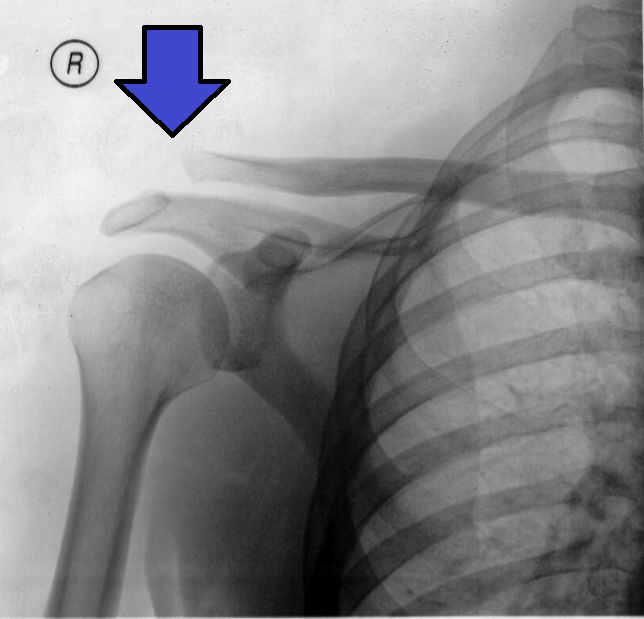
Example X-ray of an AC joint separation.
Image and video credits
AC Separation XRAY (enhanced) (opens in a new tab) — Root4(one). CC BY 2.5 (opens in a new tab).
Common Causes
AC joint separation often happens after:
- A fall onto the point of the shoulder
- A direct blow during sports
- A bicycle, skiing, skating, or car accident
- Less often, a strong pull on the arm
Common Symptoms
Patients often notice:
- Pain on the very top of the shoulder
- Swelling or bruising
- Tenderness when the area is touched
- Pain when lifting the arm, reaching overhead, or reaching across the body
- A bump or step-off at the end of the collarbone
- A feeling of weakness, shifting, or grinding at the top of the shoulder
How It Is Diagnosed
Diagnosis usually comes from:
- The story of how the injury happened
- A shoulder exam
- X-rays to look at the AC joint and rule out a fracture or other injury
Sometimes a clinician may compare both shoulders or ask you to hold a light weight during X-rays, but that is not needed in every case. Ultrasound or MRI is usually only used if the diagnosis is unclear or if another shoulder injury is suspected.
Clinicians may describe the injury as Type I through Type VI. Lower grades are milder. Higher grades have more separation and are more likely to lead to a surgical discussion.
Treatment Without Surgery
Most AC joint separations are treated without surgery.
Early treatment often includes:
- A sling for comfort
- Ice for short periods to reduce pain and swelling
- Pain medicine, such as acetaminophen or anti-inflammatory medicine, if it is safe for you to take
- Rest from heavy lifting, pushing, pulling, and sports
As pain starts to improve, gentle motion exercises are usually started so the shoulder does not get stiff. Physical therapy or a home exercise program may help restore:
- Range of motion
- Strength
- Shoulder blade control
- Comfort with overhead activity
Many people do well with nonsurgical care, even when a small bump remains.
When Surgery May Be Discussed
Surgery is not needed for most people, but it may be discussed when:
- The separation is severe
- The collarbone is far out of position
- Pain or instability does not improve with time and rehabilitation
- Your work or sports place high demands on the shoulder
- There are concerns about the skin, nerves, or blood flow
Even higher-grade separations can sometimes be treated without surgery. Surgery may be discussed when pain persists, deformity is severe, function does not recover, or another injury also needs repair. The decision is based on symptoms and goals, not the injury grade alone.
If surgery is needed, it usually aims to bring the collarbone into a better position and support or reconstruct the torn ligaments. In some cases, temporary hardware is used while the area heals.
Recovery and What to Expect
Recovery depends on how severe the injury is.
In general:
- Pain and swelling often start to improve over 1 to 3 weeks.
- Mild injuries may recover in about 2 to 6 weeks.
- More significant separations may take 6 to 12 weeks or longer before heavy lifting, contact sports, or overhead work feels safe again.
- A visible bump at the top of the shoulder may remain even after pain improves.
- After surgery, recovery usually takes several months and includes structured rehabilitation.
Most people regain good day-to-day shoulder use. Some people continue to have soreness with heavy lifting, push-ups, overhead activity, or sleeping on that side.
When to Seek Urgent Help
Seek urgent medical care right away if you have:
- Severe pain that is getting worse quickly
- Numbness, tingling, or marked weakness in the arm or hand
- Fingers that are cold, pale, or blue
- An open wound, skin that looks like it may break over the collarbone, or a major deformity after the injury
- Trouble breathing, chest pain, or other serious injuries after a hard fall or crash
When to Call the Office
Call your clinician if:
- Pain, swelling, or motion is not gradually improving
- You cannot begin gentle shoulder motion as instructed
- The bump becomes more painful, red, or swollen
- You develop fever, drainage, or redness after surgery
- You still feel unstable or cannot return to normal daily activities as expected
Prevention
You cannot prevent every injury, but these steps may lower risk:
- Use proper protective gear for contact sports and cycling
- Improve shoulder and shoulder blade strength
- Practice safe technique for sports and weight training
- Get checked after a significant shoulder injury instead of trying to push through it
Sources
References for further reading about this condition or procedure.
- Shoulder Separation (opens in a new tab)
American Academy of Orthopaedic Surgeons (AAOS), OrthoInfo