AC Joint Reconstruction
AC joint reconstruction repairs or rebuilds the ligaments that support the end of the collarbone after a shoulder separation.
Educational content only • Not a substitute for medical advice • For emergencies call 911
What This Surgery Is
The AC joint is where the collarbone (clavicle) meets the top of the shoulder blade (acromion). An AC joint injury can happen after a fall, sports injury, or direct blow to the shoulder. Mild injuries are often treated without surgery, but more serious separations can leave the joint painful, unstable, or visibly out of place.
AC joint reconstruction is surgery to restore the normal position and support of the joint. The goal is to improve pain, stability, and shoulder function.
Anatomy and imaging
These illustrations and imaging examples can help you understand the anatomy. They do not show your diagnosis.
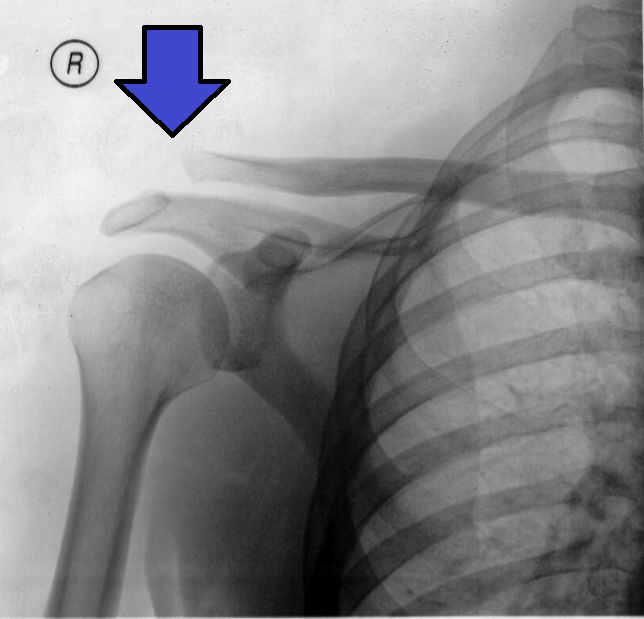
Example X-ray of an AC joint separation.
Image and video credits
AC Separation XRAY (enhanced) (opens in a new tab) — Root4(one). CC BY 2.5 (opens in a new tab).
Why Surgery May Be Recommended
Your surgeon may recommend AC joint reconstruction if:
- You have a high-grade AC joint separation with substantial deformity or functional loss after an individualized discussion of surgical and nonsurgical options
- Pain, weakness, or a feeling of instability continues after rest, sling use, and therapy
- The shoulder deformity is significant and affects function
- Your work, sports, or daily activities require a strong and stable shoulder
Not every AC joint injury needs surgery. Many people improve with non-surgical treatment.
Common Questions Before Surgery
Is this usually outpatient surgery?
Often, yes. Many patients go home the same day, but this depends on the surgery, your health, and your pain control.
What kind of anesthesia is used?
This procedure is usually done with general anesthesia. Some patients also receive a nerve block to help with pain after surgery.
What should I ask about medicines?
Ask your surgical team which medicines to stop or continue before surgery. This is especially important for:
- Blood thinners
- Diabetes medicines
- Anti-inflammatory medicines
- Vitamins or herbal supplements
Do not stop prescription medicines unless your care team tells you to.
What should I prepare at home?
It helps to plan ahead for the first few days. Patients often find these steps useful:
- Arrange a ride home
- Have loose, easy-to-put-on clothing
- Set up pillows to support the arm while resting or sleeping
- Place commonly used items within easy reach
- Ask someone to help with meals, dressing, or chores if needed
Will I be in a sling?
Yes. Most patients wear a sling after surgery to protect the repair while the shoulder starts to heal.
What Happens During the Procedure
At a high level, the surgery usually includes these steps:
- You are given anesthesia so you are asleep and comfortable.
- The surgeon may use a small camera called an arthroscope to look inside the shoulder and check for related injuries.
- A small incision is made near the AC joint.
- The surgeon repositions the collarbone and reconstructs the damaged ligaments that normally hold the joint in place.
- This may be done with a tendon graft, strong surgical tape, sutures, buttons, or a combination of these.
- The incision is closed, and your arm is placed in a sling.
The exact technique varies. Your surgeon will choose the method that best fits your injury and anatomy.
Right After Surgery
It is normal to have:
- Shoulder pain and soreness
- Swelling and bruising
- Temporary stiffness
- Tiredness from anesthesia or pain medicine
You will usually go home with:
- A sling
- Instructions for icing and wound care
- Pain-control instructions
- Activity restrictions
- A follow-up appointment
Move your fingers, wrist, and elbow as instructed so those joints do not get too stiff.
Recovery and Return to Activity
Recovery takes time because the repaired ligaments need to heal before the shoulder can safely handle more stress.
Typical recovery ranges are:
- Sling use: often about 4 to 6 weeks
- Light daily activities: often within several weeks, depending on comfort and arm control
- Desk work or schoolwork: sometimes within 1 to 2 weeks if pain is controlled and the arm is protected
- Physical therapy: often starts early with gentle motion, then progresses over weeks
- Strengthening: commonly begins after early healing, often around 6 to 12 weeks depending on the repair
- Heavier lifting, manual labor, contact sports, or overhead sports: often several months, commonly around 4 to 6 months or longer
These are general ranges. Your surgeon and therapist will tell you when it is safe to advance activity.
Risks and Possible Complications
All surgery has risks. Possible problems after AC joint reconstruction include:
- Infection
- Bleeding
- Blood clots
- Nerve or blood vessel injury
- Stiffness or loss of motion
- Ongoing pain
- Irritation from hardware
- Loss of correction, meaning the joint shifts again
- Graft stretching or failure
- Fracture of the collarbone or the coracoid process, a bony projection of the shoulder blade below it
- Need for additional surgery
Following sling instructions, activity limits, wound-care steps, and therapy guidance can help lower these risks.
When to Call the Office
Call your surgeon's office if you have:
- Fever over 101 F (38.3 C)
- Increasing redness, warmth, swelling, or drainage at the incision
- Bad-smelling drainage
- Pain that is getting worse instead of slowly better
- Trouble using the sling as instructed
- A new bump, shift, or change in shoulder position
- Numbness or tingling that does not improve
- Questions about medicines, dressings, or exercises
When to Seek Urgent Care
Seek urgent medical care right away if you have:
- Chest pain
- Trouble breathing
- The arm or hand becomes blue, very pale, or cold
- Severe swelling that is rapidly getting worse
- Sudden severe pain after a fall or injury
- Heavy bleeding that does not stop
Dr. Rizzo’s physical therapy protocols
These are my own rehabilitation protocols. Your operation, graft, and any additional repairs determine which one applies.
AC Joint Reconstruction Protocol
Use when your discharge instructions name AC joint reconstruction.
Open protocol PDF (opens in a new tab)Sources
References for further reading about this condition or procedure.
- Shoulder Separation (opens in a new tab)
American Academy of Orthopaedic Surgeons (AAOS), OrthoInfo