Clavicle Fracture
A clavicle fracture is a broken collarbone, usually caused by a fall or direct blow to the shoulder.
Educational content only • Not a substitute for medical advice • For emergencies call 911
What It Is
A clavicle fracture is a break in the collarbone, the bone that connects your breastbone to your shoulder. This bone helps hold the shoulder in position and supports arm movement.
Broken collarbones are common after:
- A fall onto the shoulder
- A fall onto an outstretched hand or arm
- A sports collision
- A bike, motorcycle, or car crash
Most clavicle fractures heal well. Many do not need surgery.
Anatomy and imaging
These illustrations and imaging examples can help you understand the anatomy. They do not show your diagnosis.
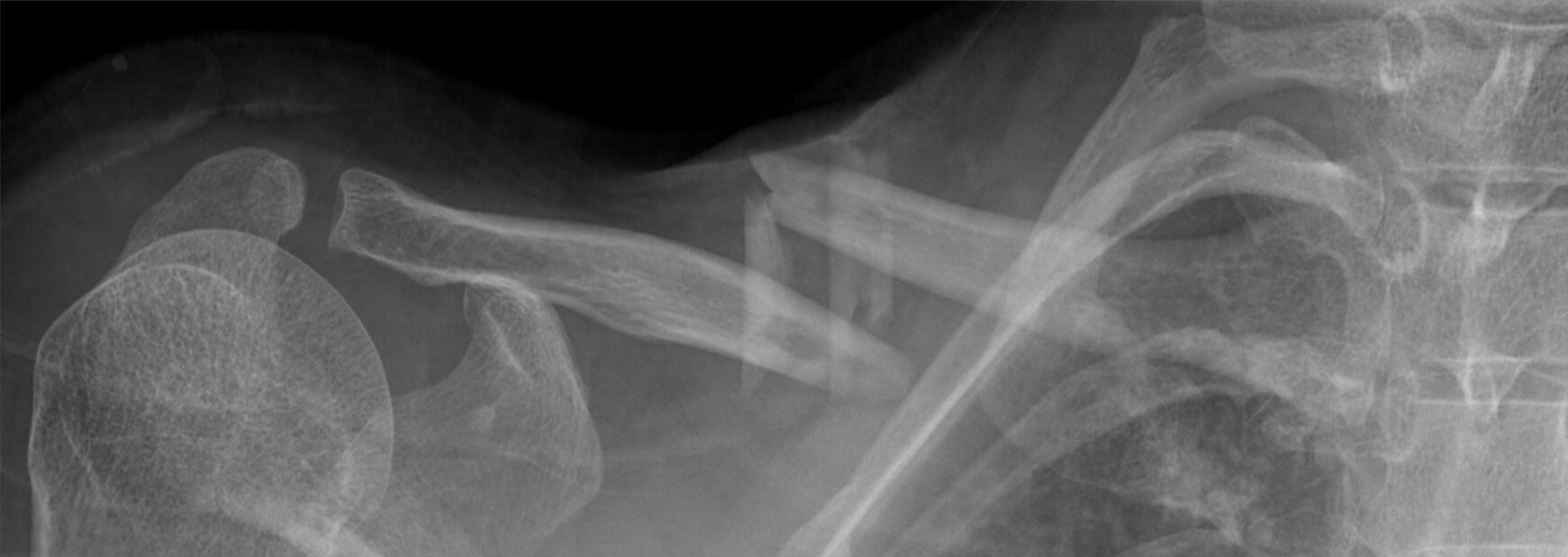
Example X-ray of a displaced fracture in the middle of the collarbone.
Image and video credits
Typische mittlere Klavikulafraktur mit verkippten Kleinfragmenten 39W - CR - 001 (opens in a new tab) — Hellerhoff. CC BY-SA 4.0 (opens in a new tab). Modification: Image metadata removed and recompressed as JPEG for web delivery.
Common Symptoms
Patients often notice:
- Pain over the collarbone or top of the shoulder
- Swelling, bruising, and tenderness
- Pain when moving the arm
- Trouble lifting the arm because of pain
- A bump or change in shape over the collarbone
- The shoulder looking lower or more forward than usual
- Grinding, clicking, or crackling with movement
How Diagnosis Is Made
A clinician will ask how the injury happened and examine the shoulder, collarbone, skin, and arm. They will also check feeling, strength, pulse, and blood flow in the arm and hand.
X-rays are the main test used to confirm the fracture and show whether the bone pieces are lined up well. A CT scan is sometimes used if the break is more complex, is near a joint, or surgery is being considered.
Treatment
Nonsurgical Care
Most clavicle fractures are treated without surgery, especially if the broken pieces have not shifted very far out of place.
Nonsurgical treatment often includes:
- A sling to support the arm while the bone heals
- Ice for pain and swelling
- Pain medicine, if needed, as recommended by your clinician
- Gentle motion of the fingers, wrist, and elbow to prevent stiffness
- Gentle shoulder exercises later, when your clinician says it is safe
- Follow-up visits and X-rays to make sure healing stays on track
A simple sling is the most common treatment. Even if pain starts to improve early, the bone still needs time to heal.
When Surgery May Be Discussed
Surgery is not needed for most people, but it may be discussed if:
- The broken pieces are far apart or badly out of line
- The bone has broken through the skin
- The bone is pressing hard on the skin
- There is concern for injury to nearby nerves or blood vessels
- The fracture has several pieces or is unstable
- The bone is slow to heal or does not heal well with nonsurgical care
Surgery usually uses a plate and screws or a rod/pin to hold the bone in place while it heals. Possible risks include infection, irritation from the hardware, numbness near the incision, and sometimes another procedure later to remove hardware.
Recovery and What to Expect
Most people regain good shoulder function.
General healing expectations:
- Adults often need about 6 to 12 weeks for the bone to heal
- Children and teens often heal faster
- Sling use is common for the first few weeks, but timing depends on the fracture
- Light daily activities usually return before heavy lifting, overhead activity, or sports
- Return to sports, gym, or heavy work usually waits until the bone has healed and strength has returned, often around 3 months or longer
It is common to have a small bump where the bone heals. This often gets smaller with time but may not go away completely. Some soreness, weakness, or stiffness can last for a few months. Some people benefit from physical therapy during recovery.
Tips During Healing
- Wear the sling as directed
- Use ice wrapped in a cloth for short periods to help with pain and swelling
- Keep your fingers, wrist, and elbow moving unless you were told not to
- Start shoulder exercises only when your clinician says it is safe
- Do not lift, push, pull, or play contact sports until you are cleared
- Avoid smoking and nicotine if possible, because they can slow bone healing
- Eat regular meals with enough protein and other nutrients to support healing
When to Get Urgent Help
Get urgent medical care right away if:
- Bone is sticking out through the skin
- The skin over the fracture looks very tight, pale, or like it may split
- Your hand or arm becomes numb, weak, cold, blue, or very pale
- You cannot move your fingers normally
- Pain or swelling suddenly gets much worse
- You have trouble breathing, chest pain, or cough up blood after the injury
- You injure the same shoulder again
When to Call the Office
Call your care team if:
- Pain is not improving as expected
- The sling is causing rubbing, sores, or does not fit well
- You notice more deformity or a new popping feeling
- You have fever, increasing redness, drainage, or a bad smell from a wound or surgical incision
- You are unsure when to start exercises or return to work, school, sports, or lifting
Sources
References for further reading about this condition or procedure.
- Clavicle Fracture (Broken Collarbone) (opens in a new tab)
American Academy of Orthopaedic Surgeons (AAOS), OrthoInfo